AKILAH WATTS, ALANIS FORDE, ANNA GIBSON
REIMAGINED II:
UNDER THE GALVANIZED ROOF
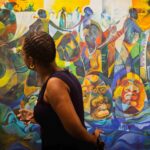
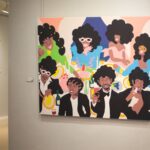
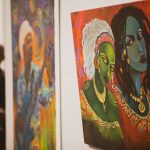
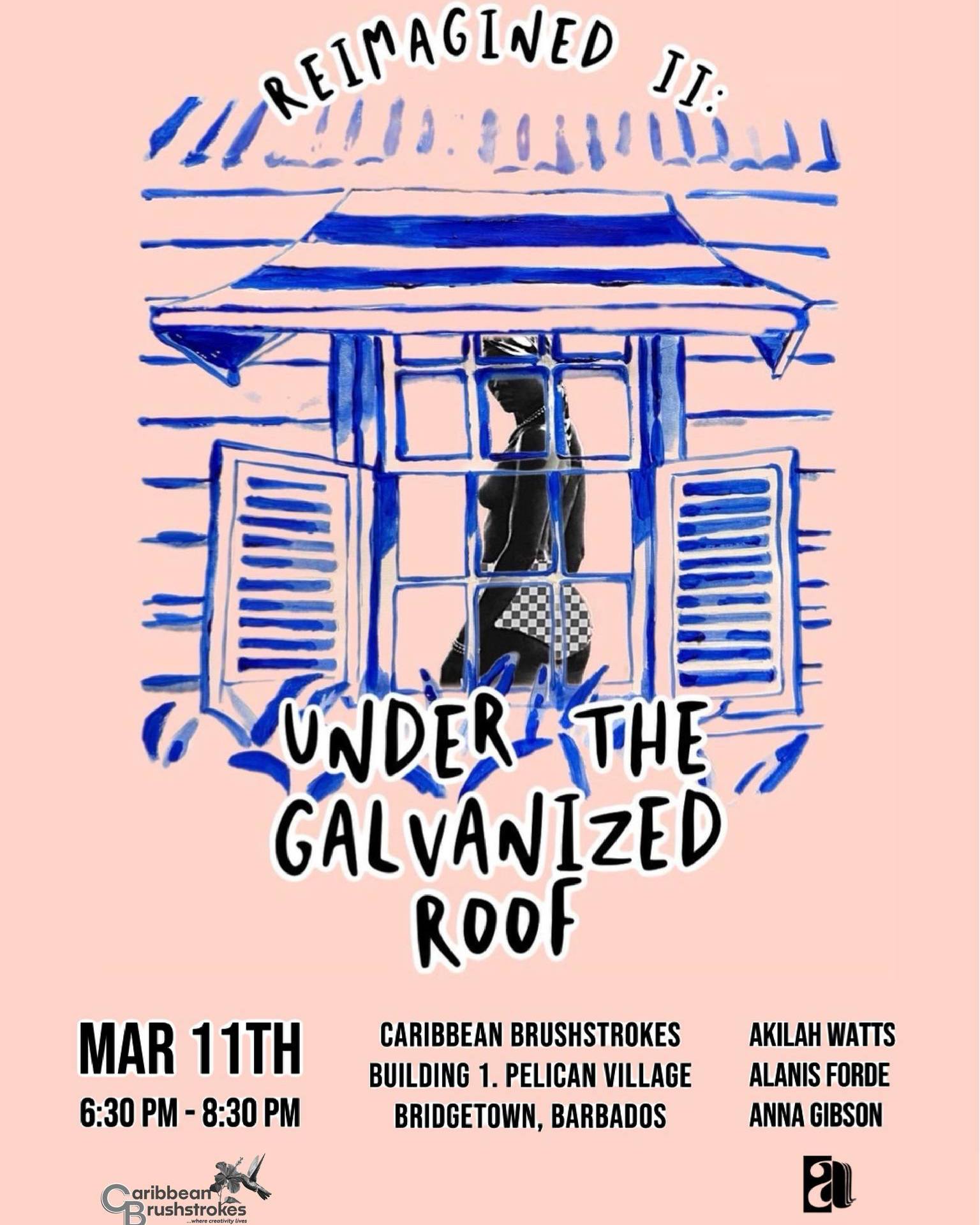
Reimagined II: 'Under the Galvanized Roof' takes the concept of the chattel house, often misused, misunderstood and categorised, as an element present only in what can be considered 'Tourist’ art and flips that concept completely on its head. The Three A’s, Akilah Watts, Alanis Forde and Anna Gibson, transform the Caribbean Brushtrokes Gallery into a memoryscape recreation of the home, and invite us to deconstruct the preconceived notions of what a Chattel House can mean.
The Chattel House refers to an old style of home prevalent within the Caribbean landscape. Constructed entirely out of wood, it was meant to be easily assembled and disassembled in the event of land disputes, and gained its name 'chattel' precisely because the houses were mobile.
This style of home has quickly become a relic of the past, being replaced with more modern 'wall houses' (buildings made from brick). The chattel house itself has become, in many minds, an indicator of wealth and class.
While the artists’ opinions on the Chattel house as an indication of status seemed to differ based on who was asked, there was consensus on the fact that the Chattel House, as constructed within the gallery, was more about memory, childhood, and familial relationships than it was about conversations of income and wealth inequality.
There are very few pieces within Reimagined II that have been handled by a single artist. Having worked as a collective for the better part of a decade, the Three A’s have developed a unique relationship with the need for ‘individuality’, that is often ascribed to the idea of the contemporary artist. Elements and signatures unique to each artist's individual works are woven into each painting, making the entire gallery space a collective memory rather than elements forced to exist in isolation.
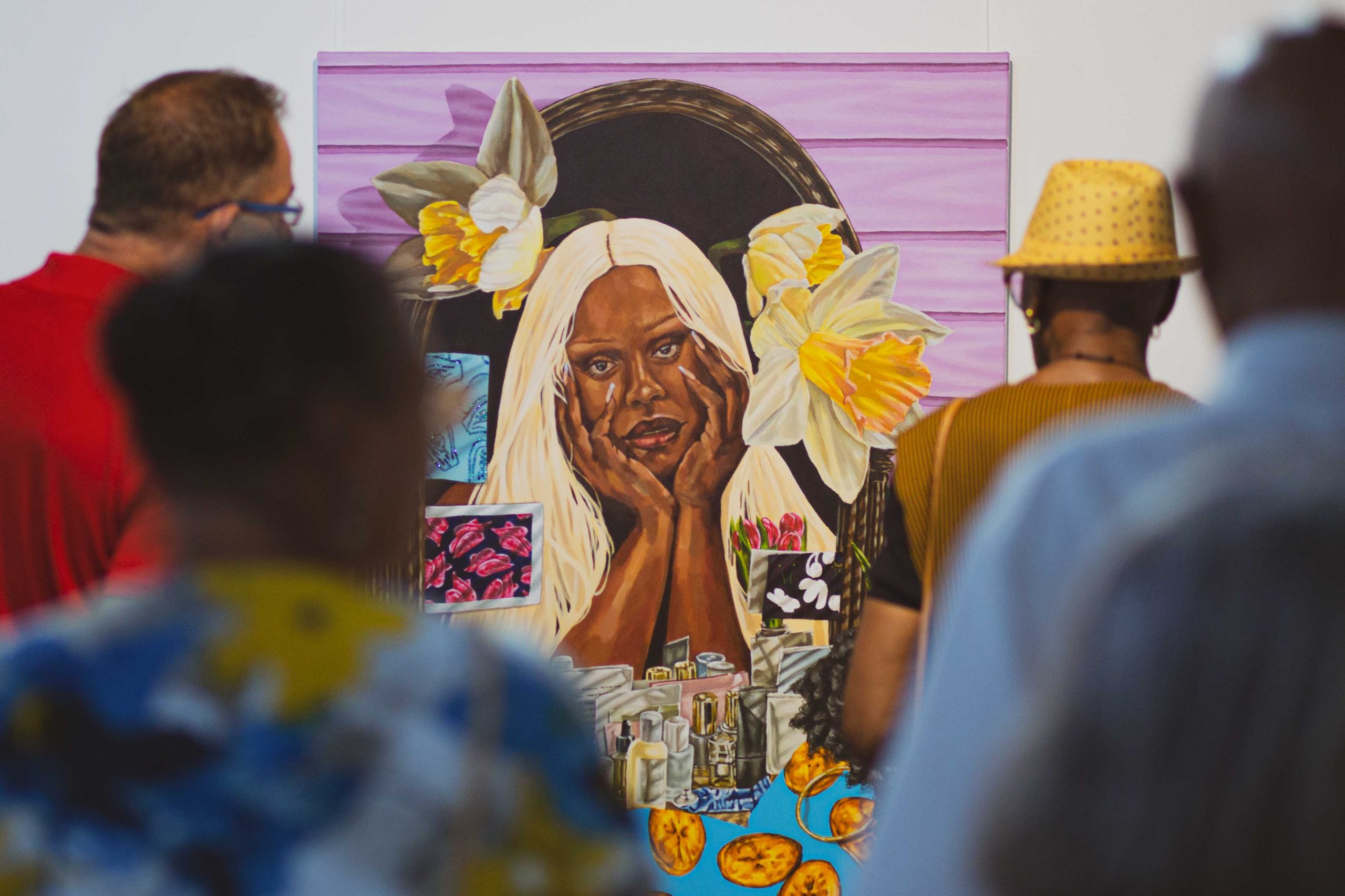
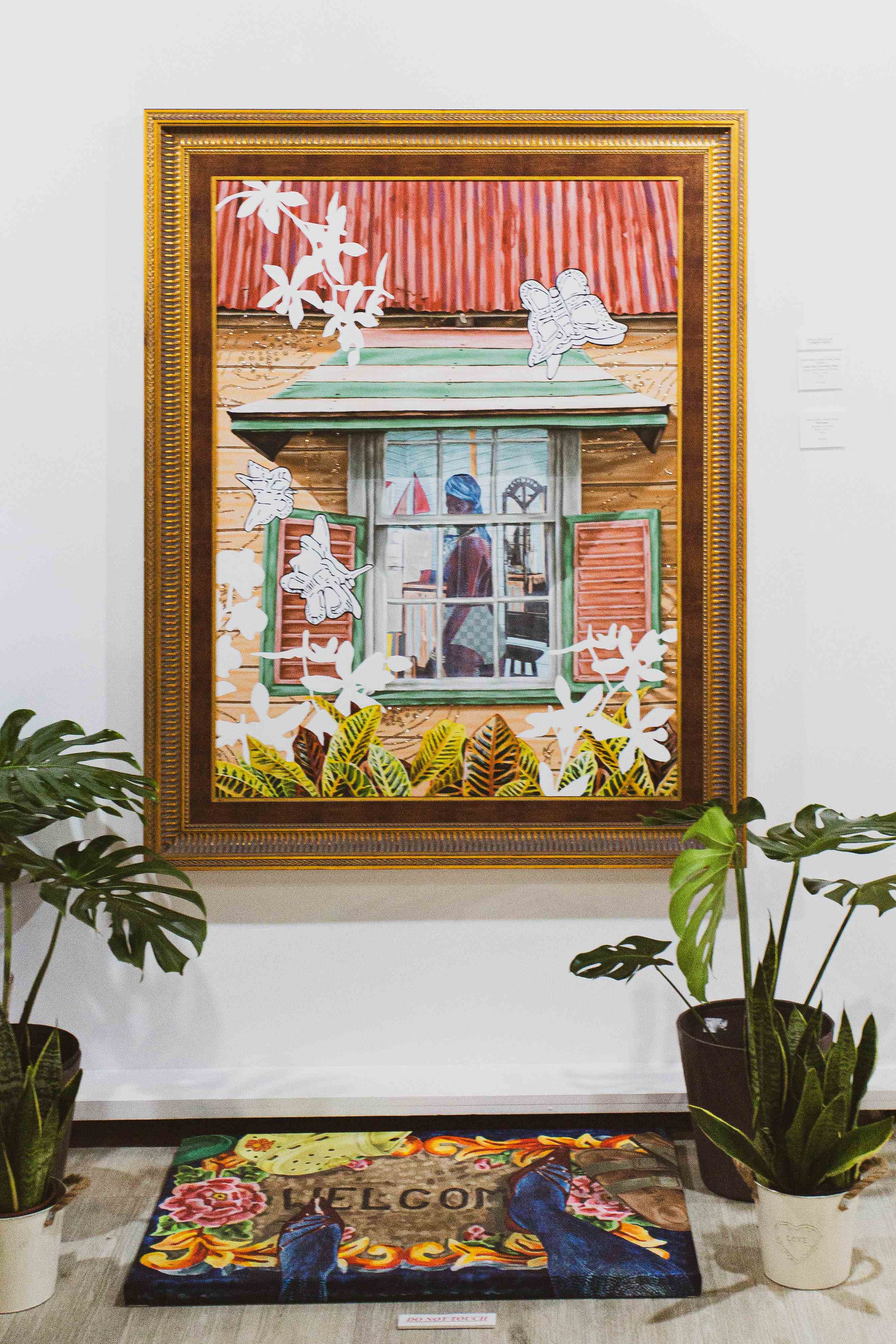
Below: 'Welcome' by Alanis Forde and Anna Gibson
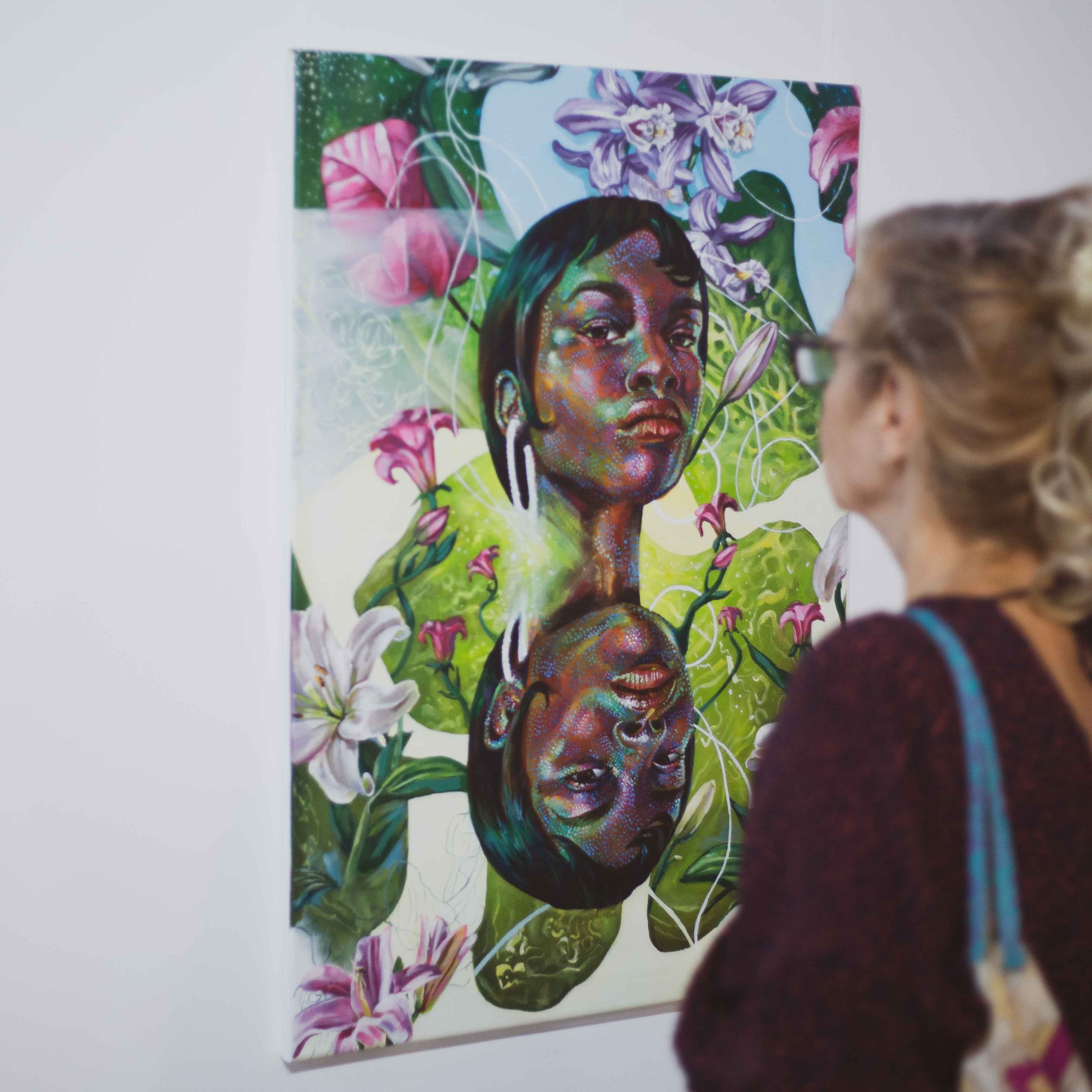
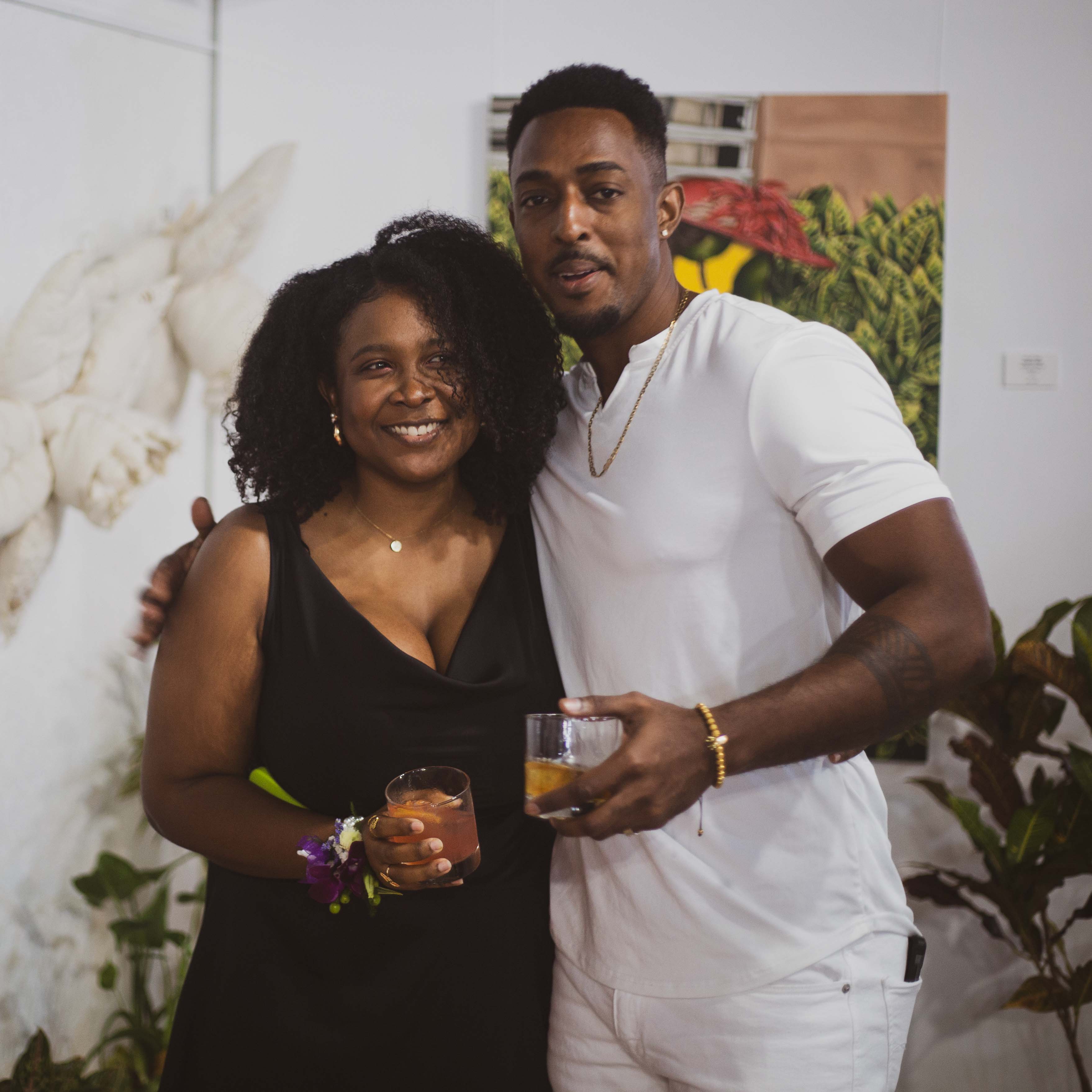
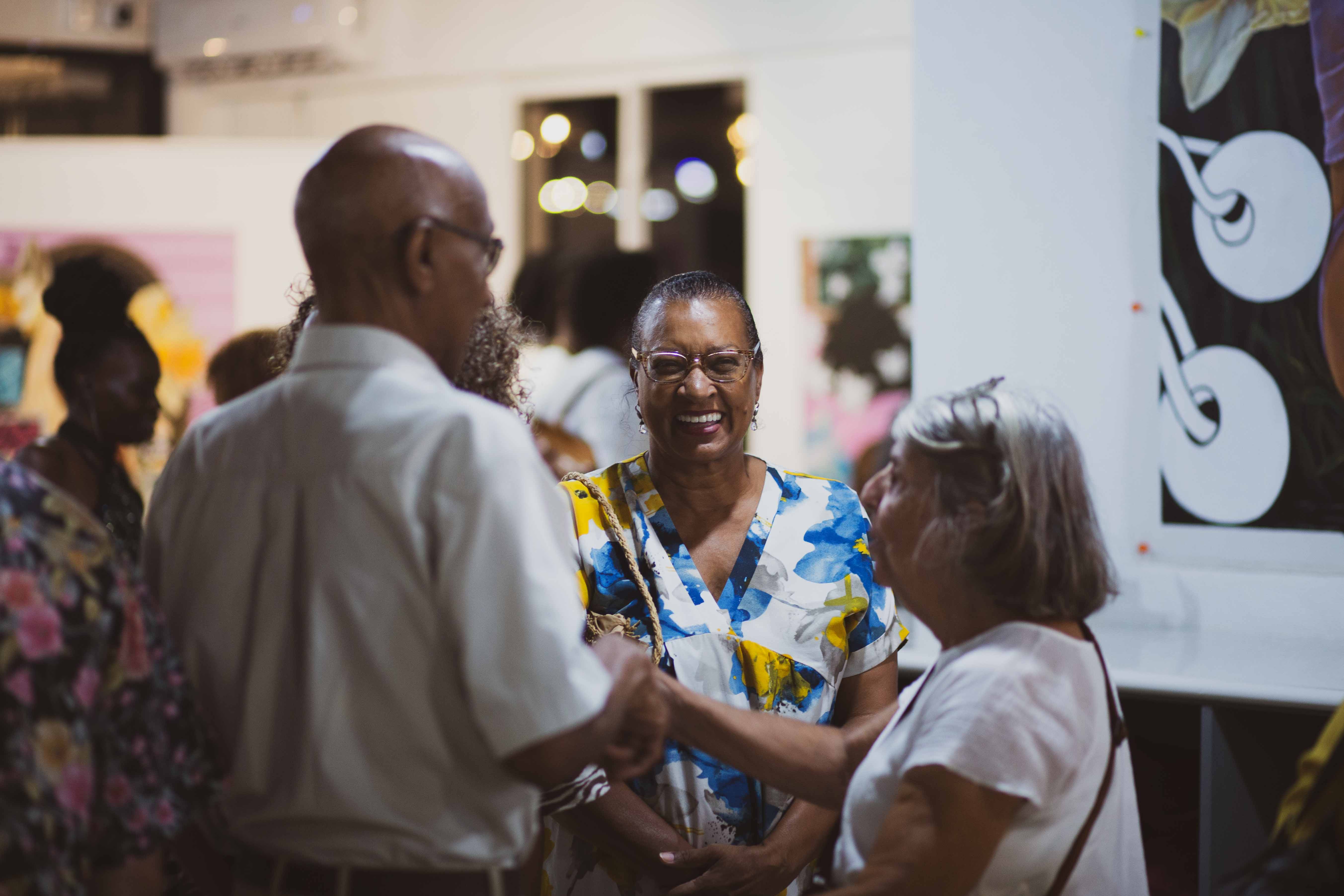
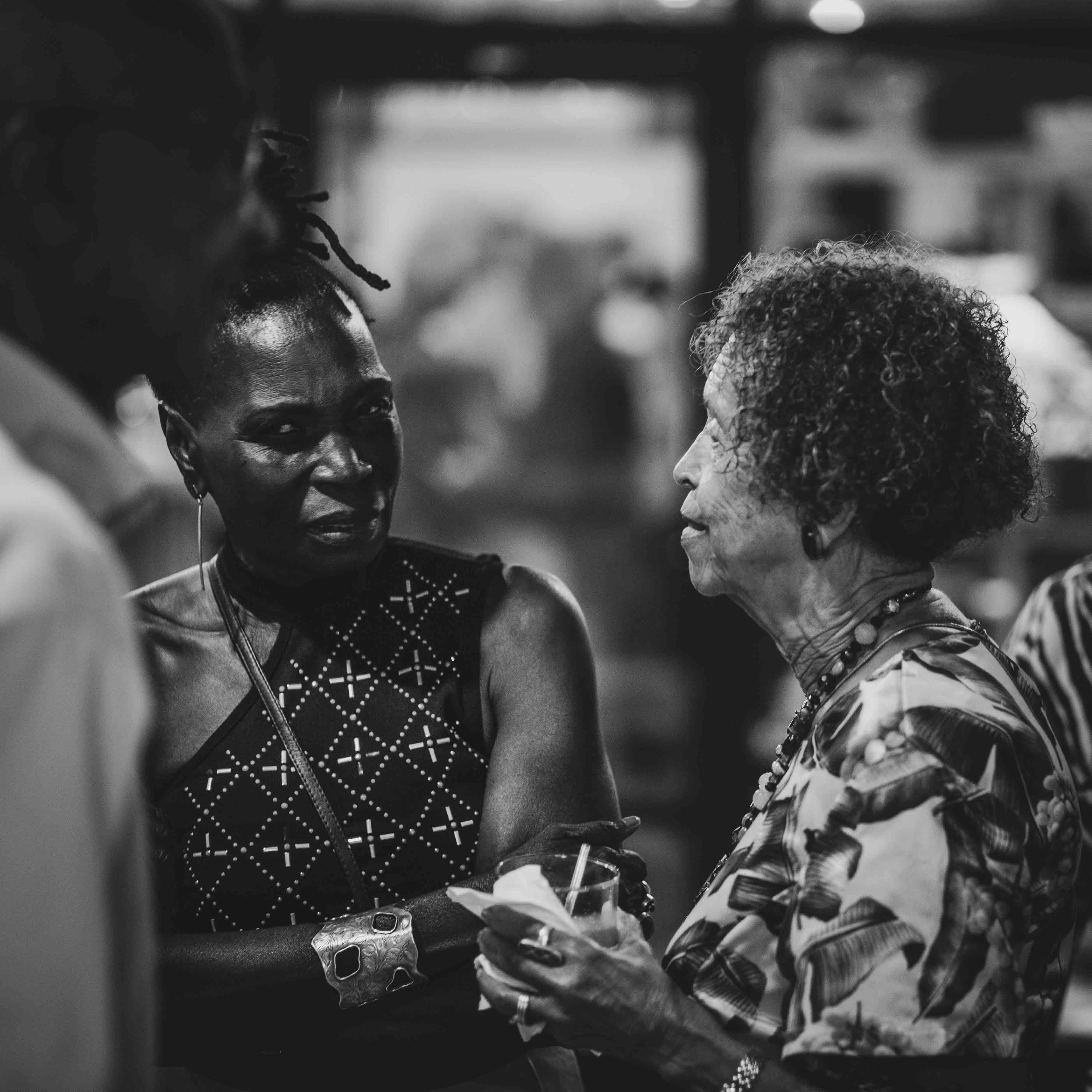
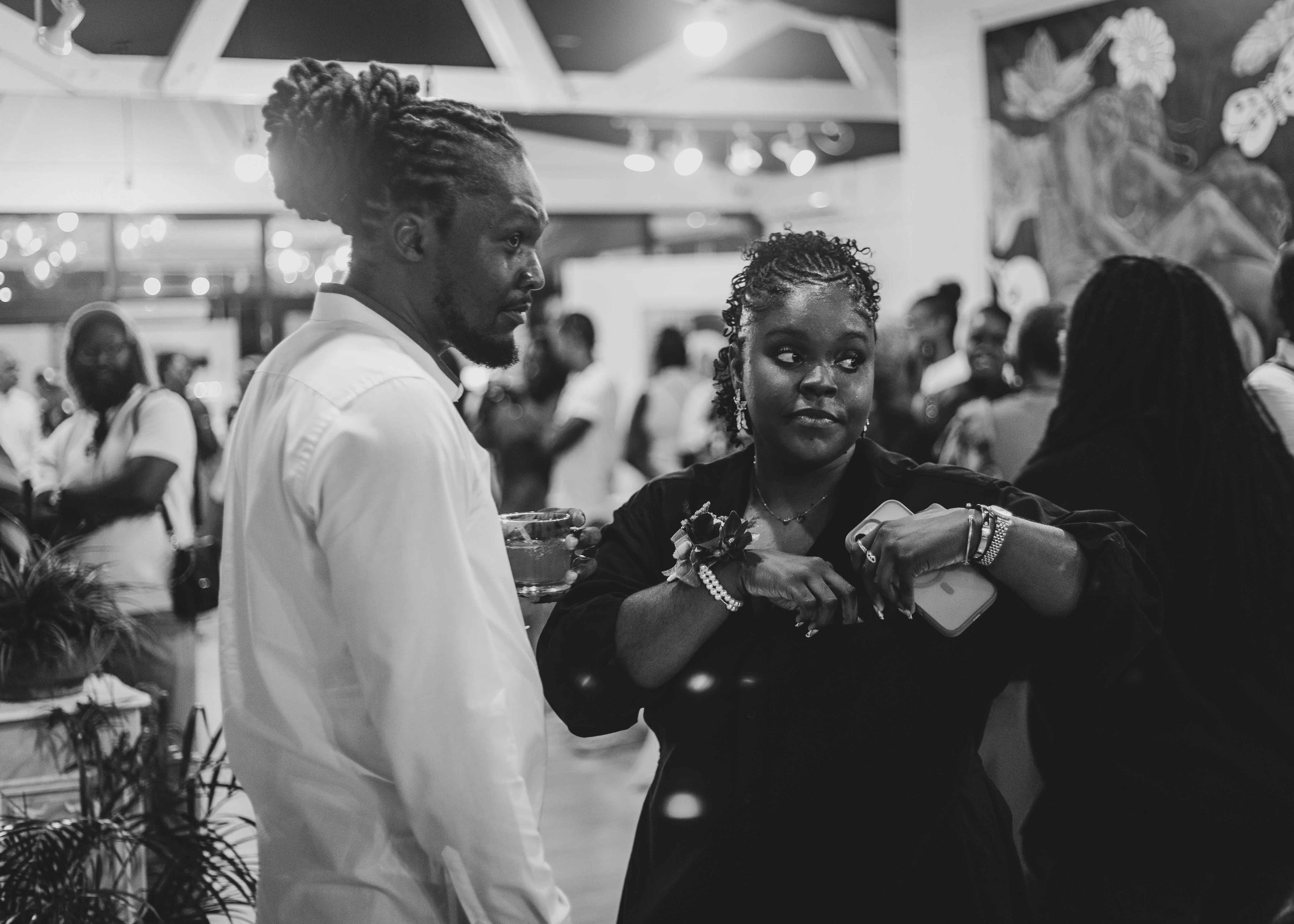
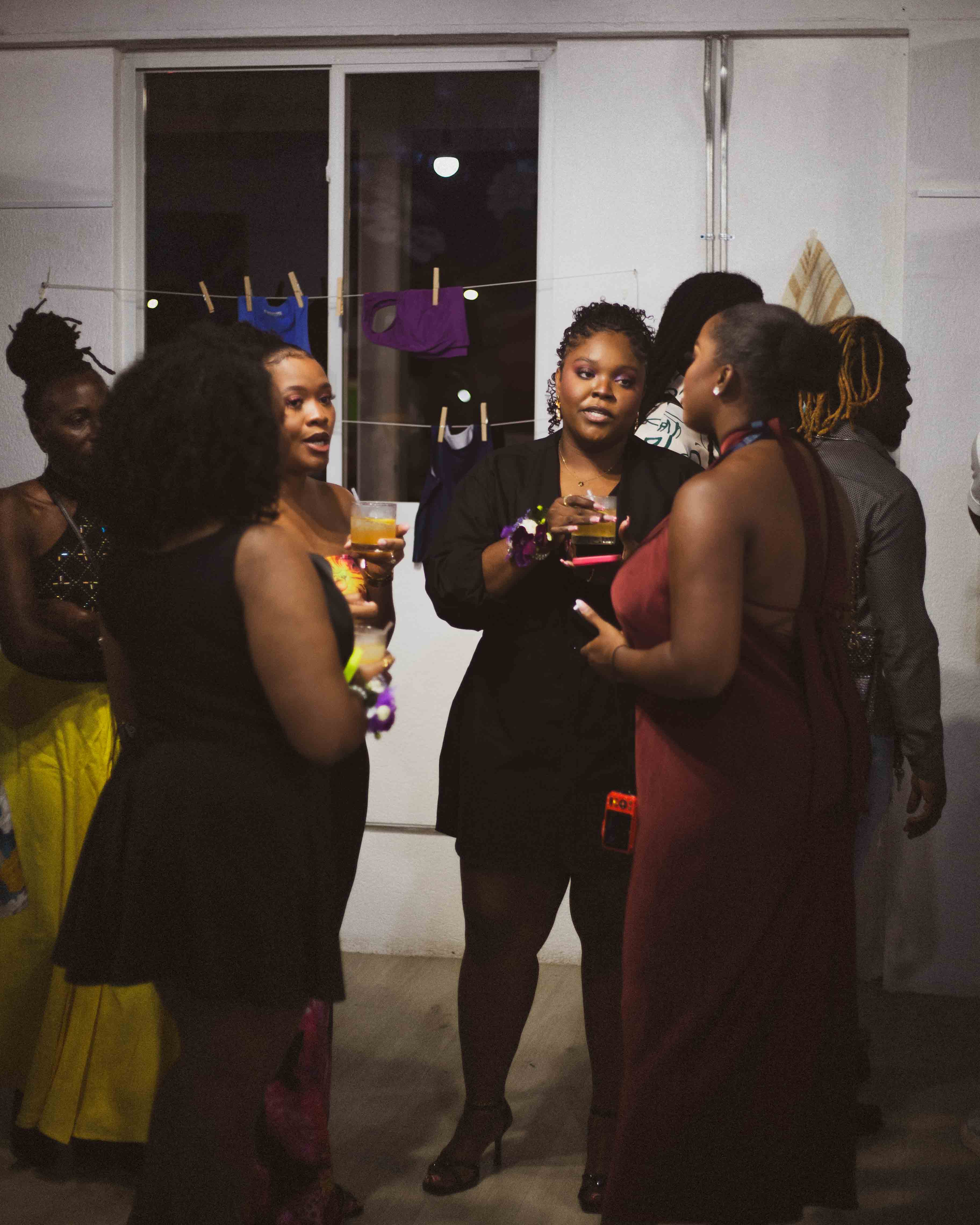
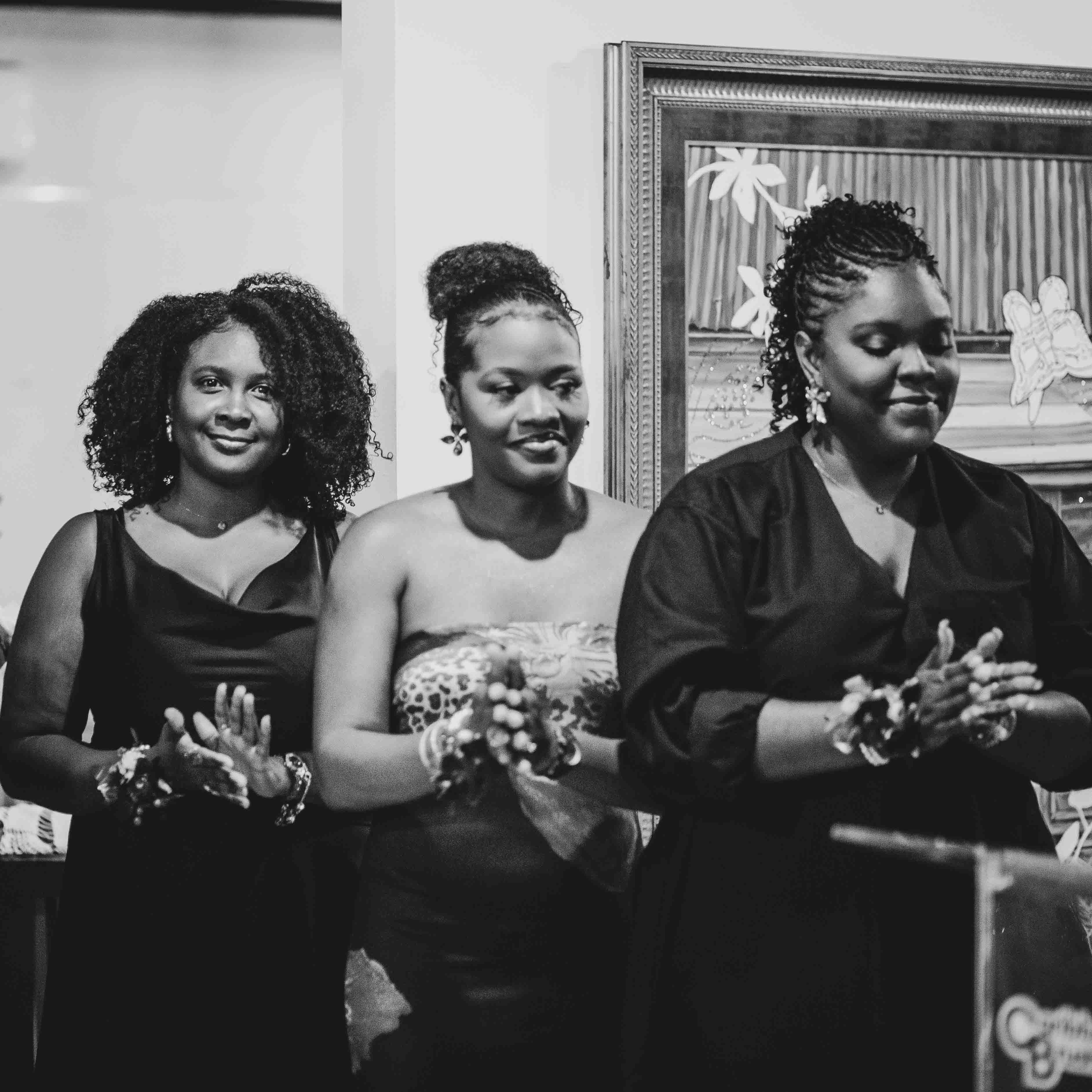
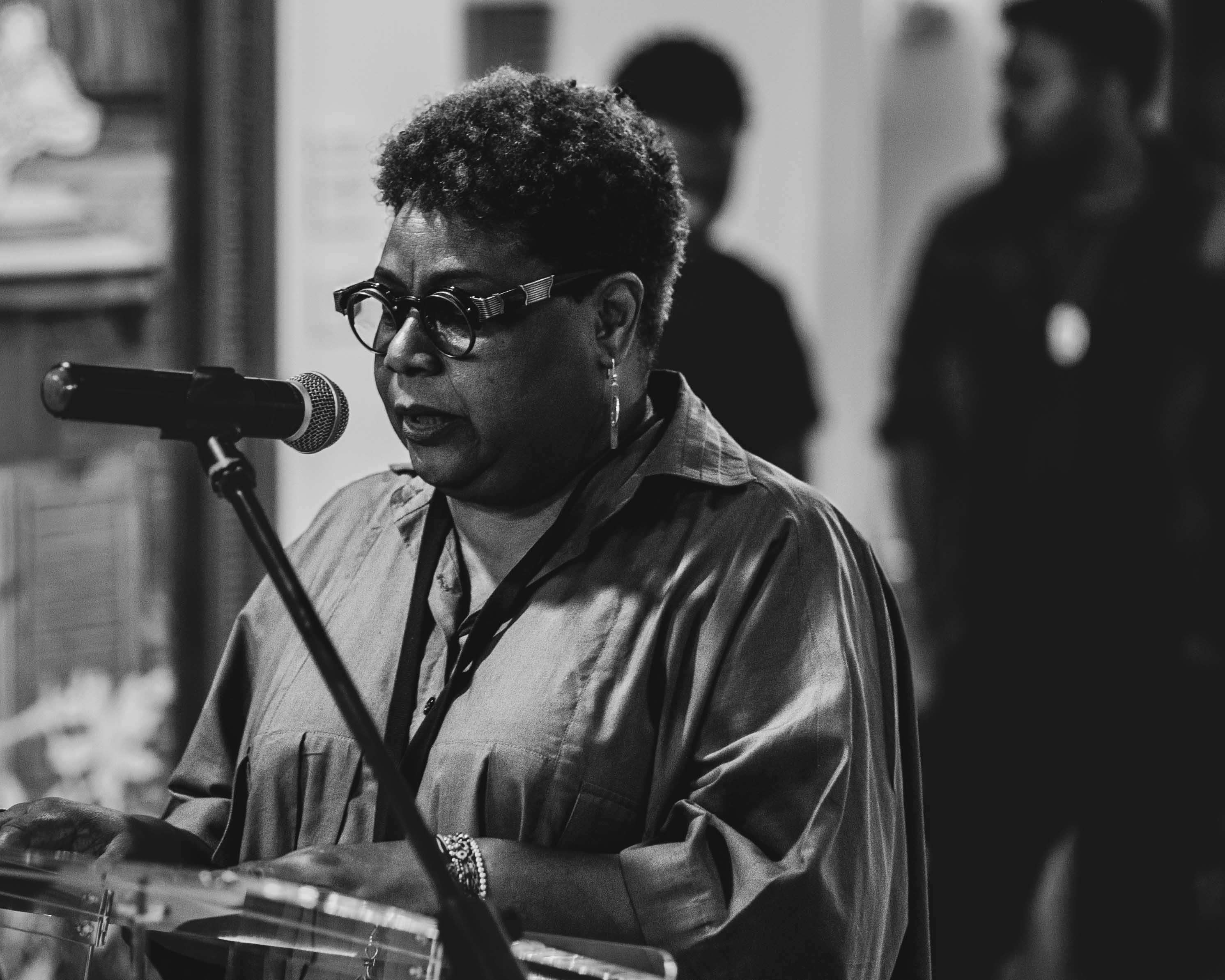
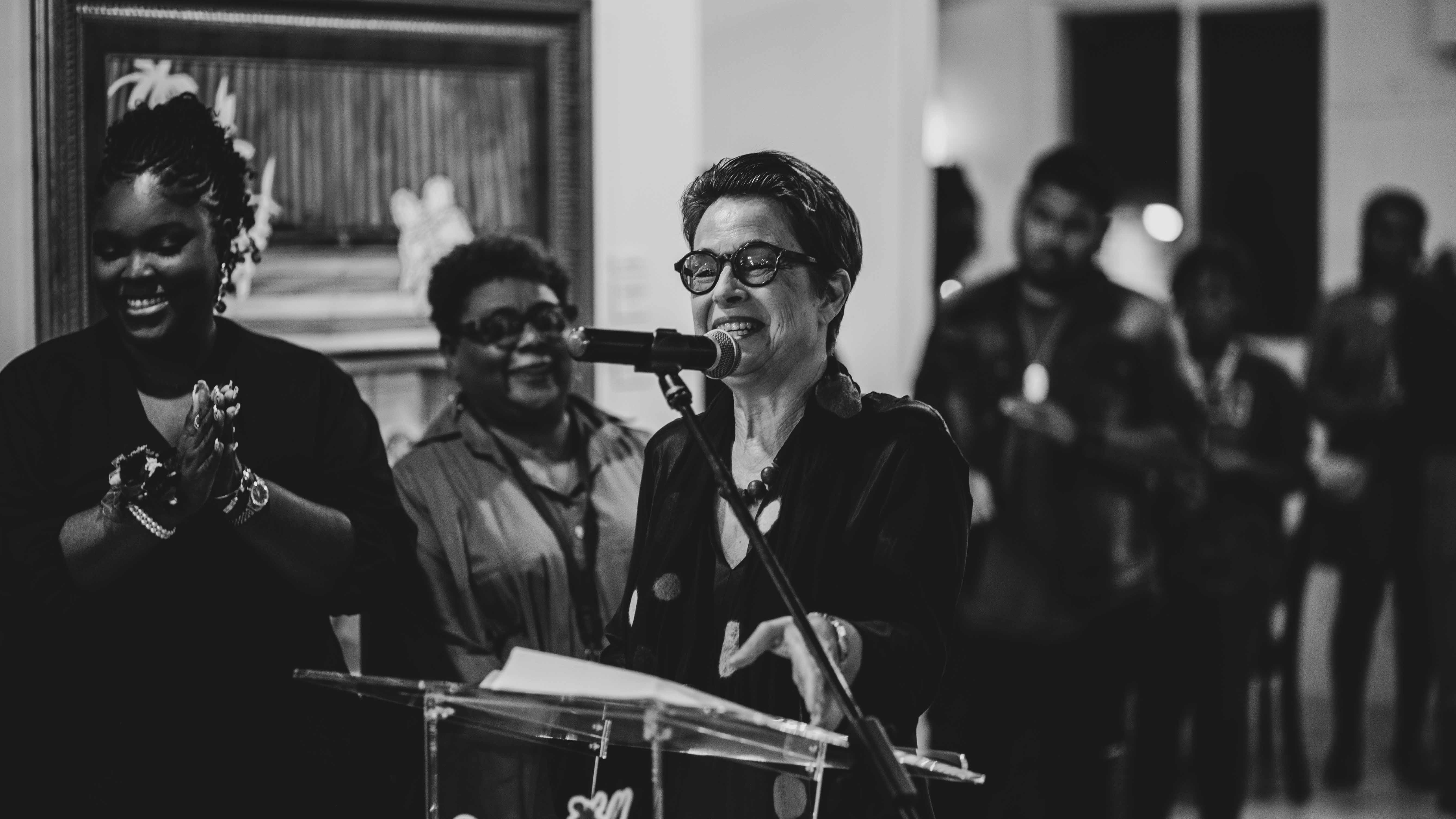
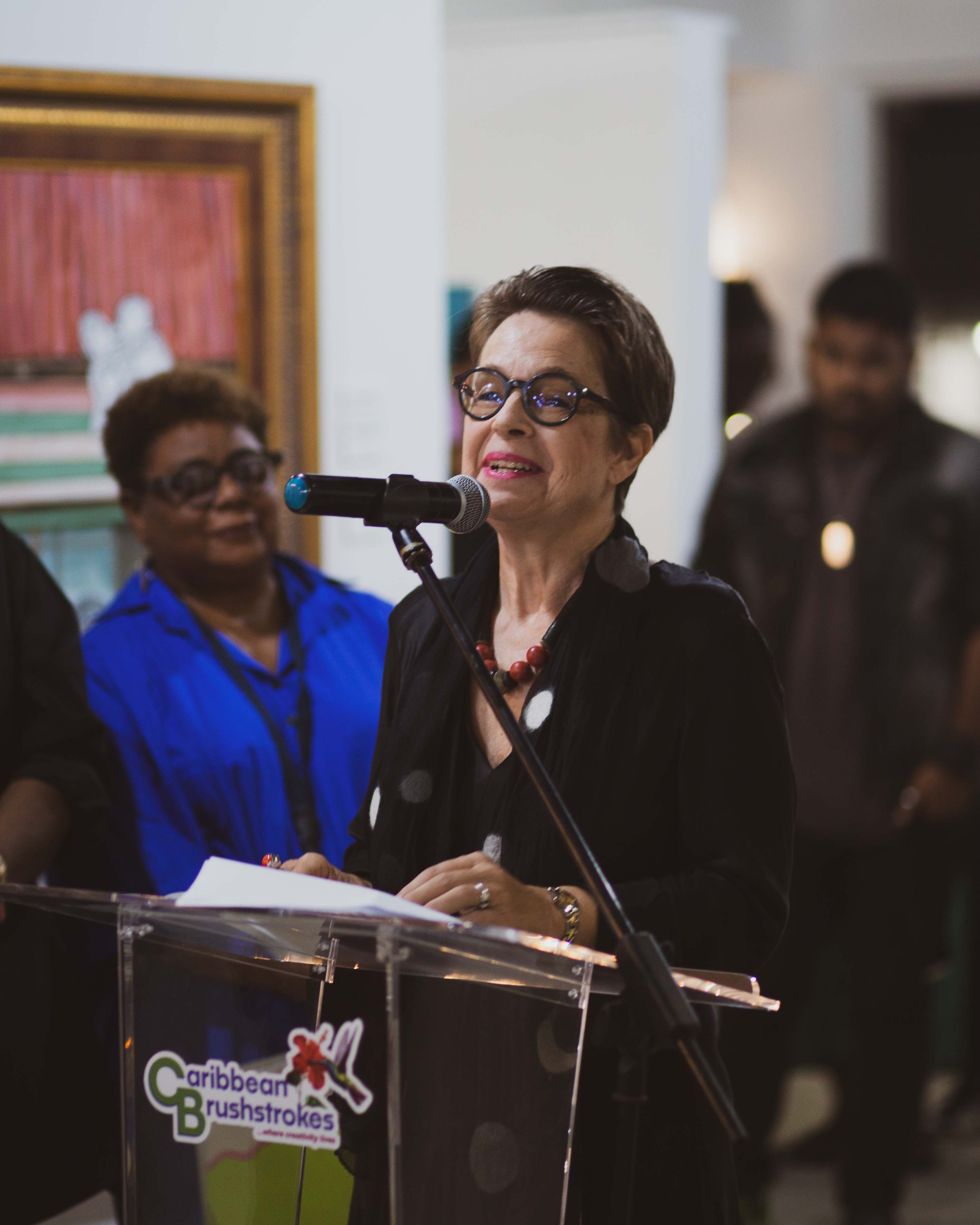
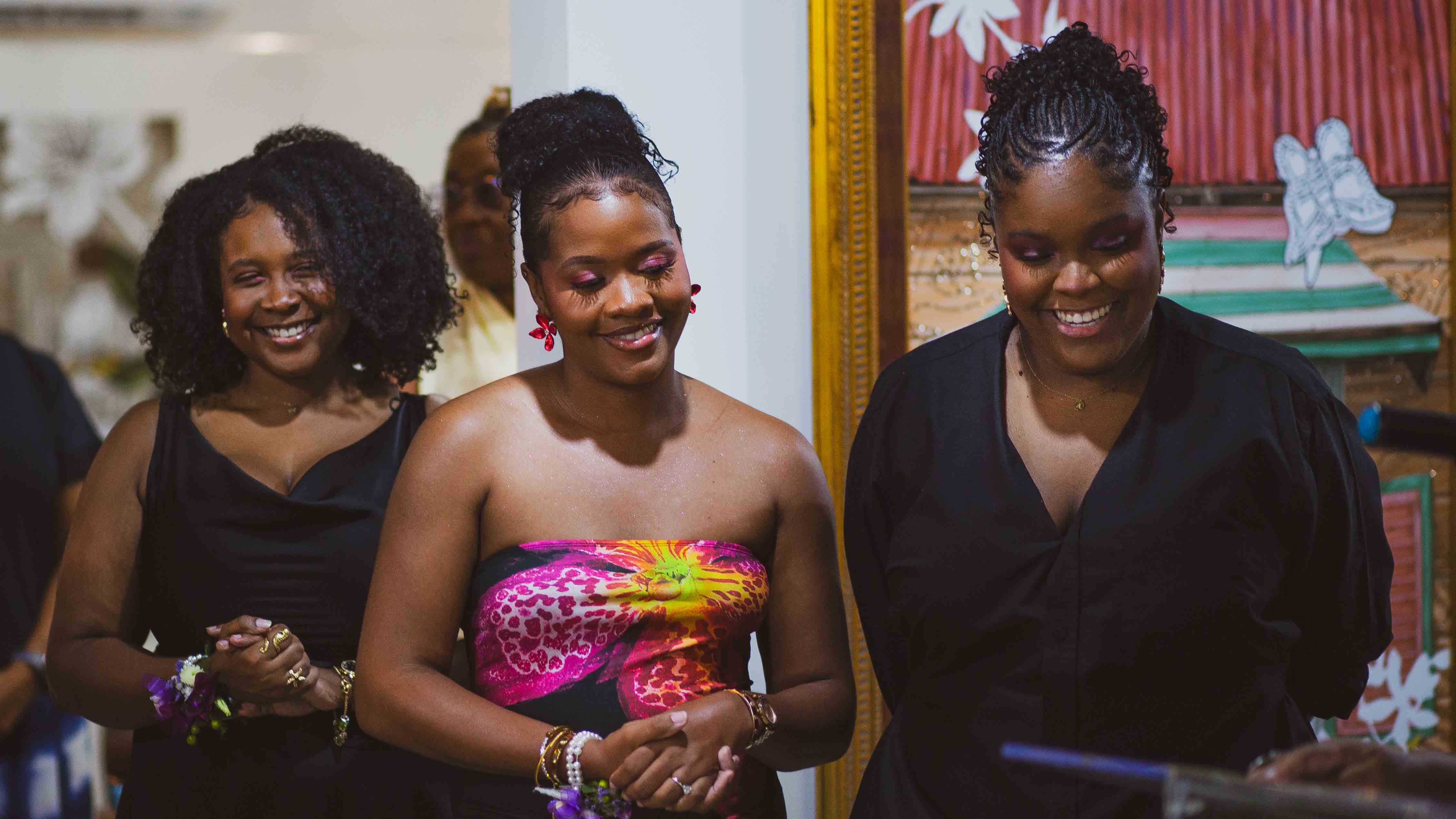
Opening Remarks by Dr Therese Hadchity
Having worked with the Three A’s previously, Dr Therese Hadchity (art historian and educator at the University of the West Indies, Cave Hill Campus) returned to their second group exhibition to deliver the opening remarks.
Identifying the exhibition’s Chattel House as that of a ‘remembered house’, Hadchity emphasised to the viewers both the domestic nature of the space created and the preconceptions and social implications that come from the Chattel House as a concept.
According to Hadchity, elements of the cultural, nostalgic and historical are inescapable. Still, as this house is one of reimagining, it is up to the viewer, as they explore the installation, to consider “…what potential the chattel house and all it represents holds for us today.”
“The Chattel house is therefore not simply a piece of real estate but a time capsule, a collective and individual memory palace and, of course, an important testimony to Barbadian history struggles and social dynamics.
So the very structure of the exhibition and its arrangement as a domestic space, and its anticipation that we, the viewers, will layer it with our own memories and projections that double down on the entanglements that have always suffused the work of all three artists. What I'm talking about here is the inseparability of the past and the present, the internal and the external, the visible and the invisible, the personal and the social that their works have become.”
Opening Remarks by Dr. Therese Hadchity
THE CONCEPT:
The Chattel House Divided
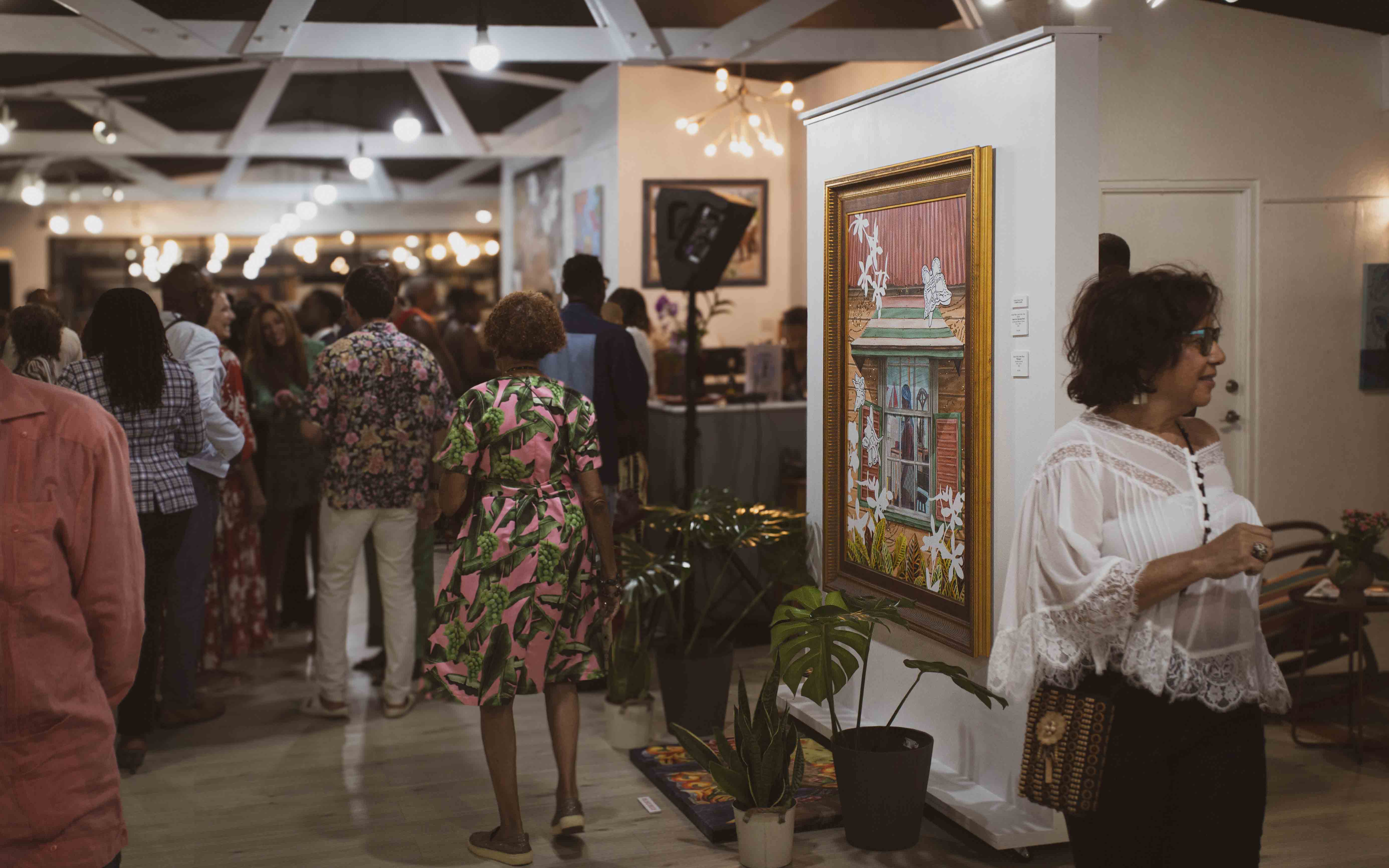
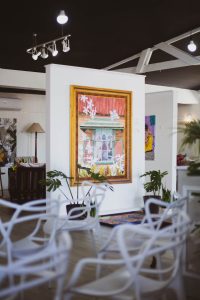
For this exhibition, the gallery was transformed into the distinct rooms of a house. This allowed the viewer to effectively walk through an artistic reconstruction of a traditional Barbadian home. For those familiar, it was intended to spark the beginnings of nostalgia, allowing the viewer to overlap their own memories of the chattel house with those of the artists. The reimagining comes from the recreation, and the artists’ ability to make one reconsider the place of the chattel house within contemporary art.
It is undeniable that the staging is the main support when it comes to the portrayal of the home. The movable walls used within the Caribbean Brushstrokes Gallery are employed to maximum effect, creating the physical walls to serve as dividers between each room. The traditional mahogany furniture (lounge chairs, dining tables and benches) is also vital to this representation, and it is crucial that the furniture used is not “modern”, but an accurate representation of the type of furnishings still found in homes of this kind.
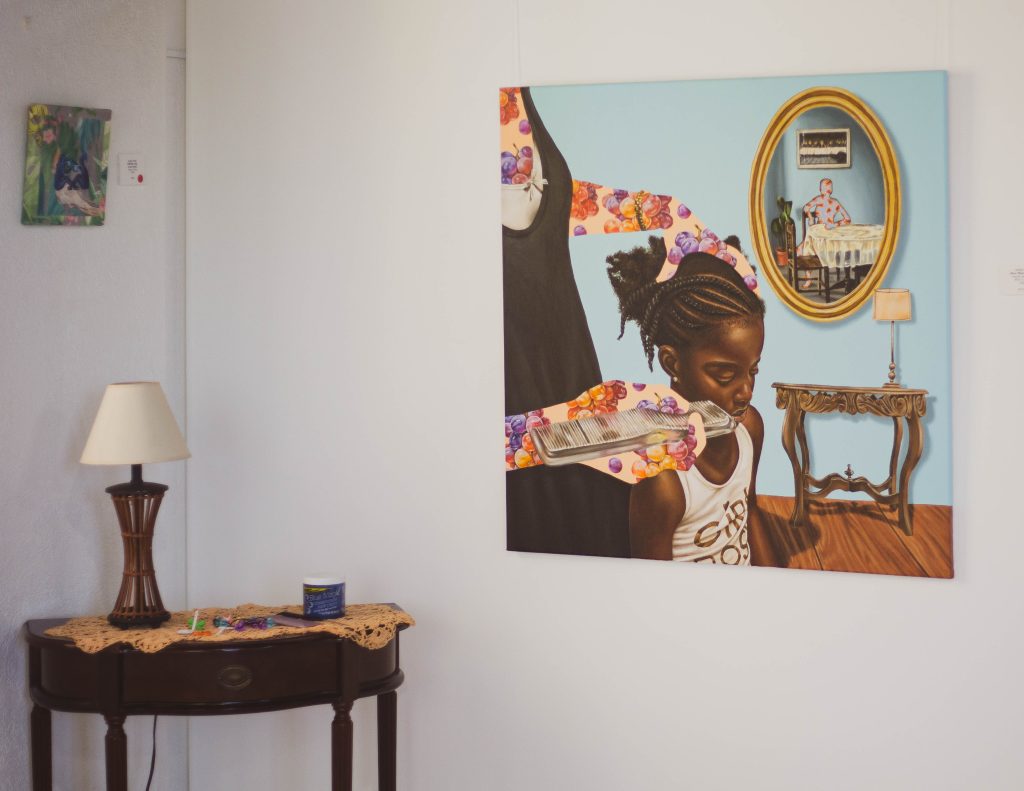
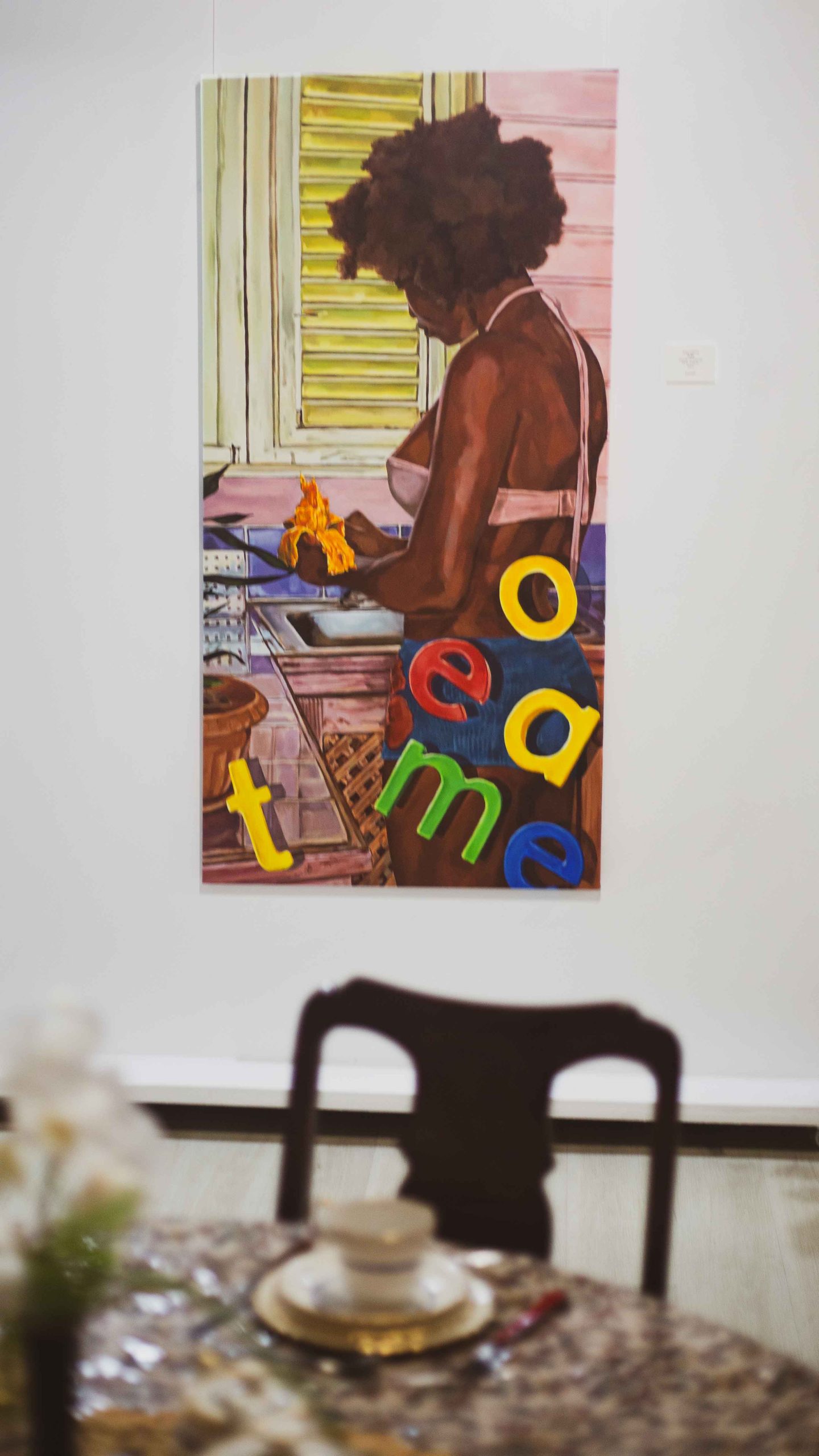
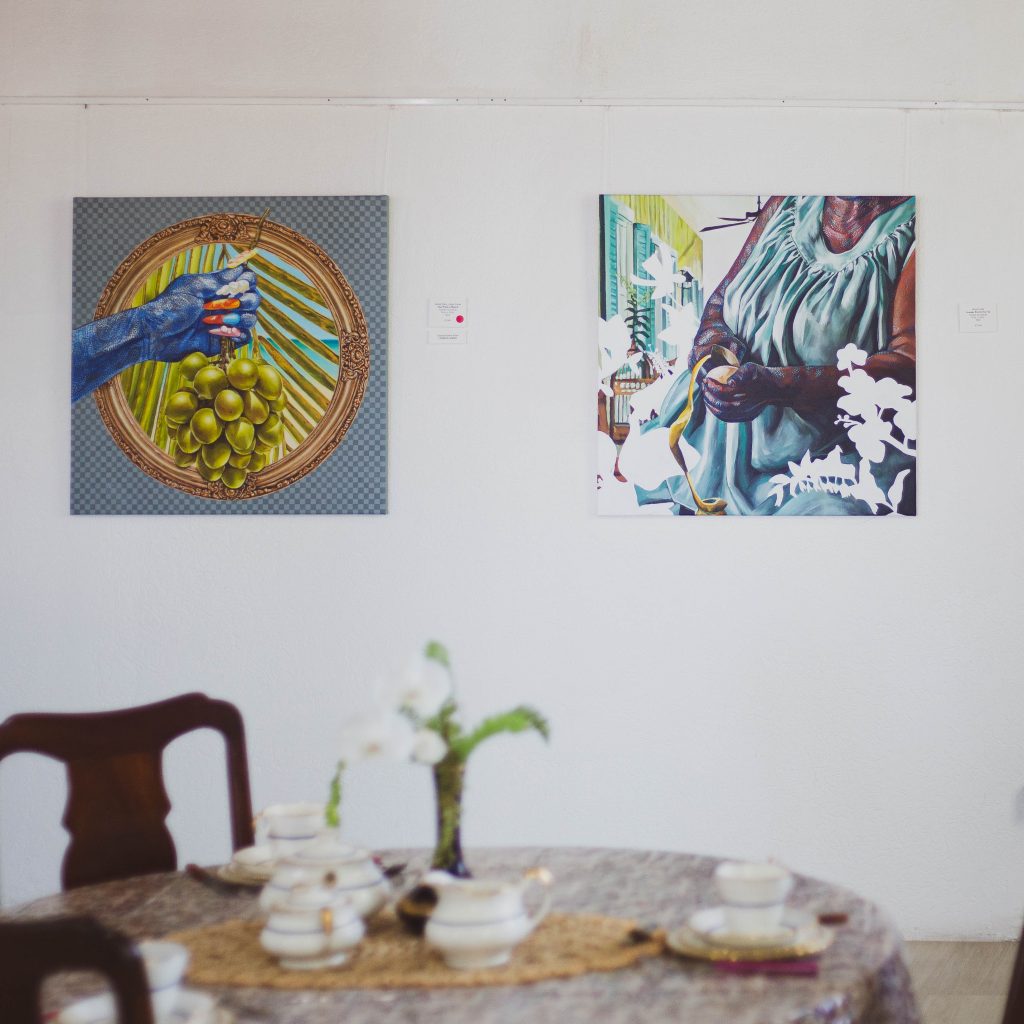
Within this exhibition, the paintings and other works become the windows into the lives of those who occupy this house of memory: the welcome mat at the entrance as one removes their shoes after a long day of work, a child having their hair braided, the peeling of a mango, the watching of television or the fixing of makeup in a vanity…there is a closeness to the pieces on display. A slow and easy comfort in the choice of subject matter that makes it clear that the subjects are not being consciously observed but quietly remembered.
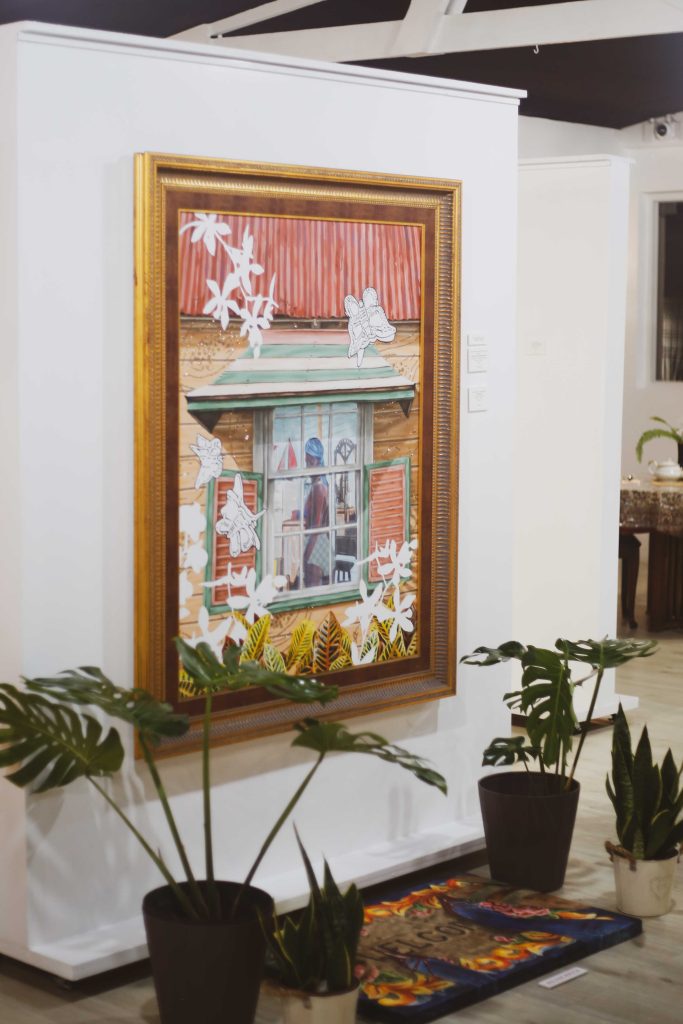
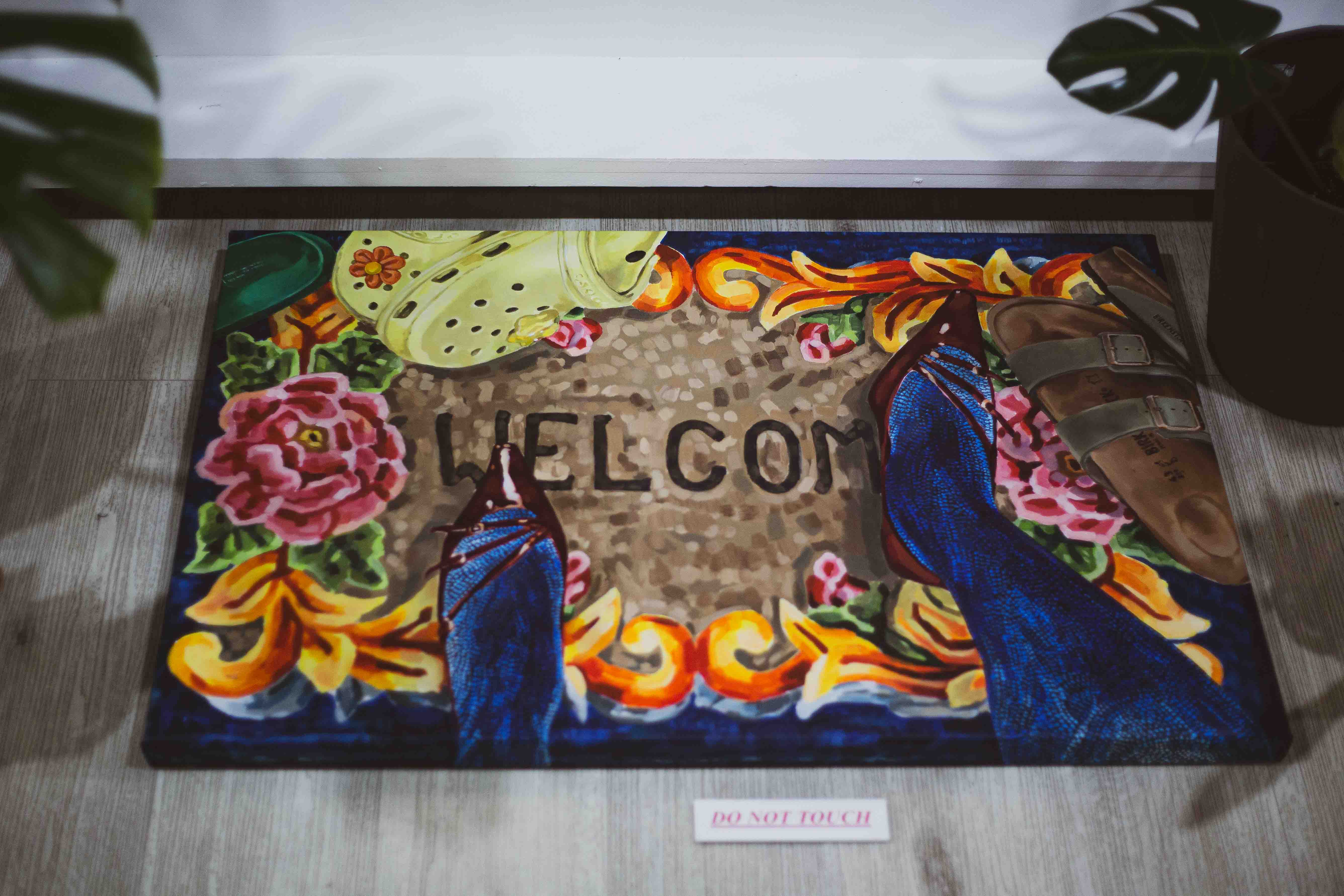
THE ENTRANCE
As one enters the gallery, they are greeted by the exterior of the Chattel house and the welcome mat on the floor. There are already shoes removed at the entrance. This is a lived-in home.
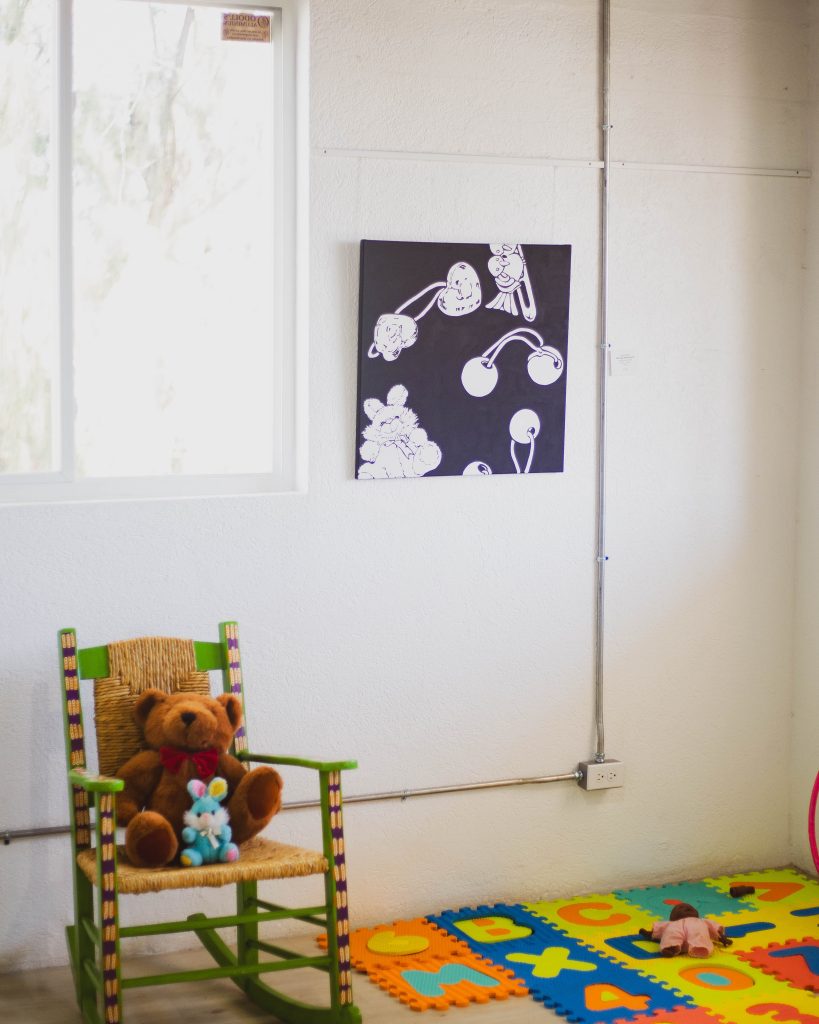
THE CHILD'S ROOM
Furnished with a rocking chair, abandoned toys and a colourful mat. The quiet moment of a child having her hair braided is contrasted against the stark black-and-white paintings of children’s toys, their lack of colour representing their relegation to the past.
THE KITCHEN
The dining table sits, ready for visitors, a familiar plastic covering the patterned tablecloth. An adult familial figure peels fruit for the viewer; our lowered child-like perspective adds another layer of nostalgia to the scene.
THE LIVING ROOM
The Living Room is furnished with wooden seating, side tables, old unread newspapers and a rug to make it all comfortable. It is the communal space for shared experiences, where we go to watch television with family or sit and enjoy each other's presence.
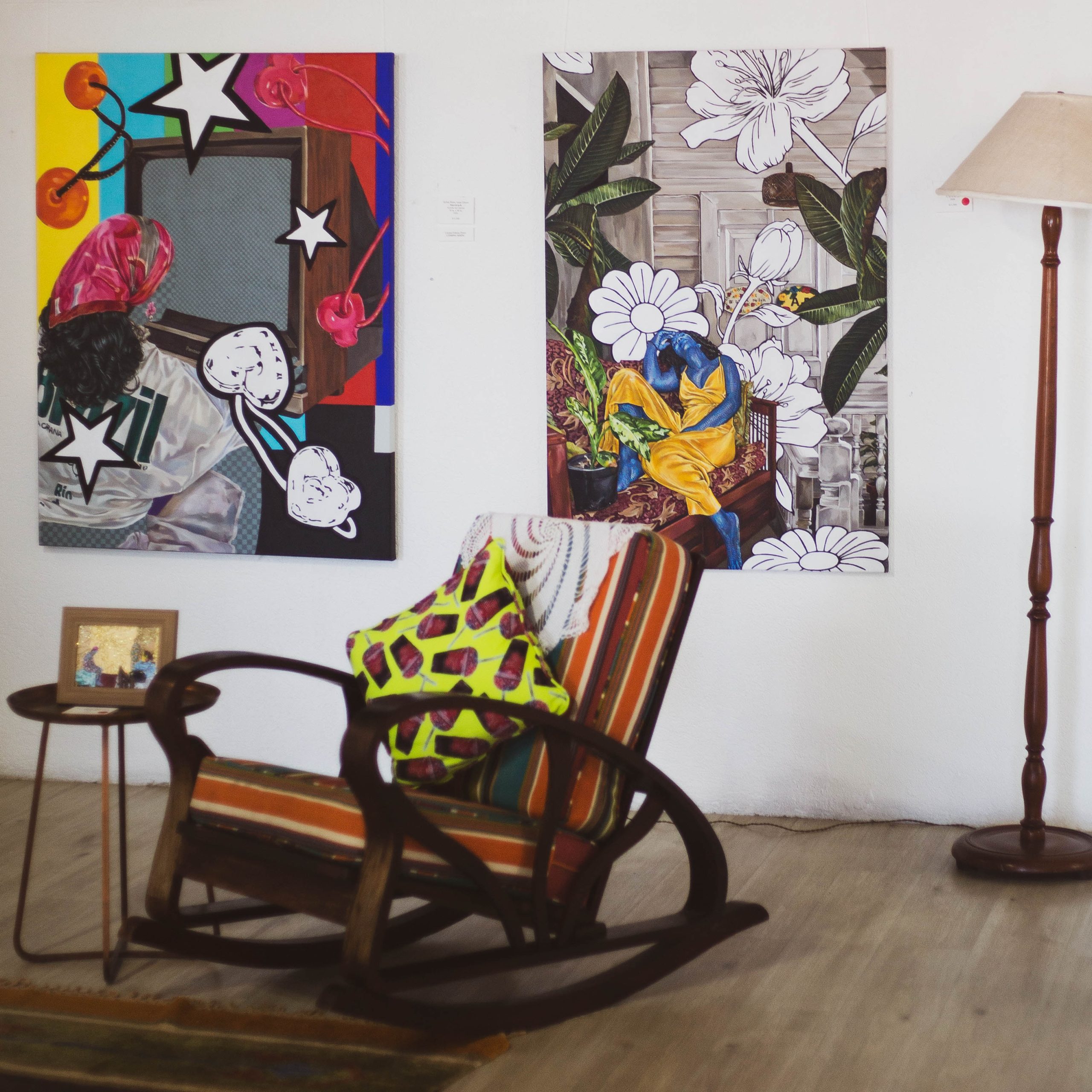
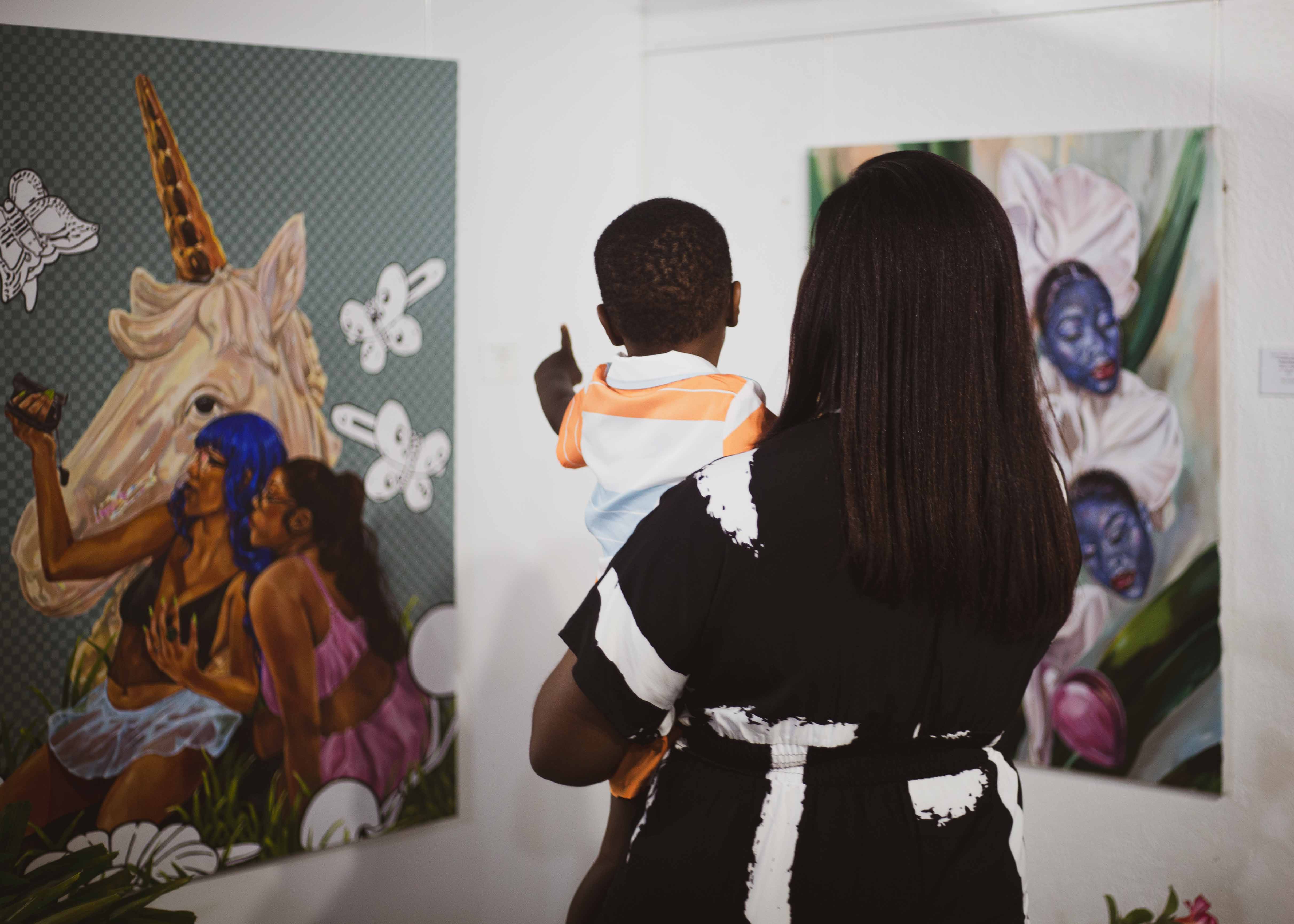
Right: 'Off in Her Own World' by Alanis Forde and Anna Gibson
THE GARDEN
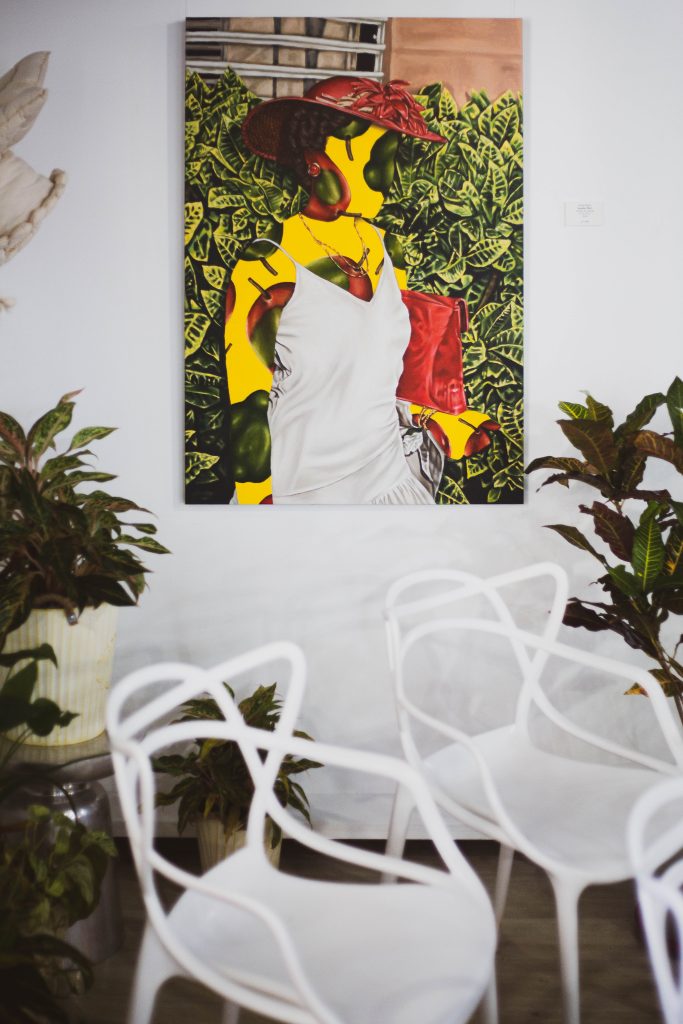
The artists take the time to fill this space with all of the houseplants needed to give the feeling of an outdoor green space. As one enters the gallery, the entrance is immediately ahead, to your left is the garden, completed with a wooden bench for seating.
THE BATHROOM
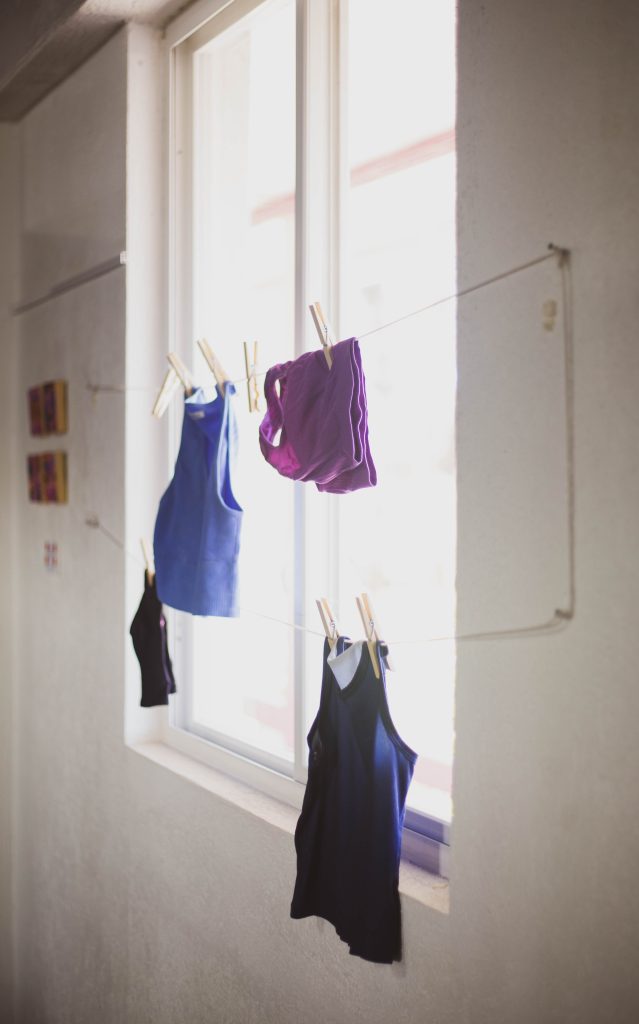
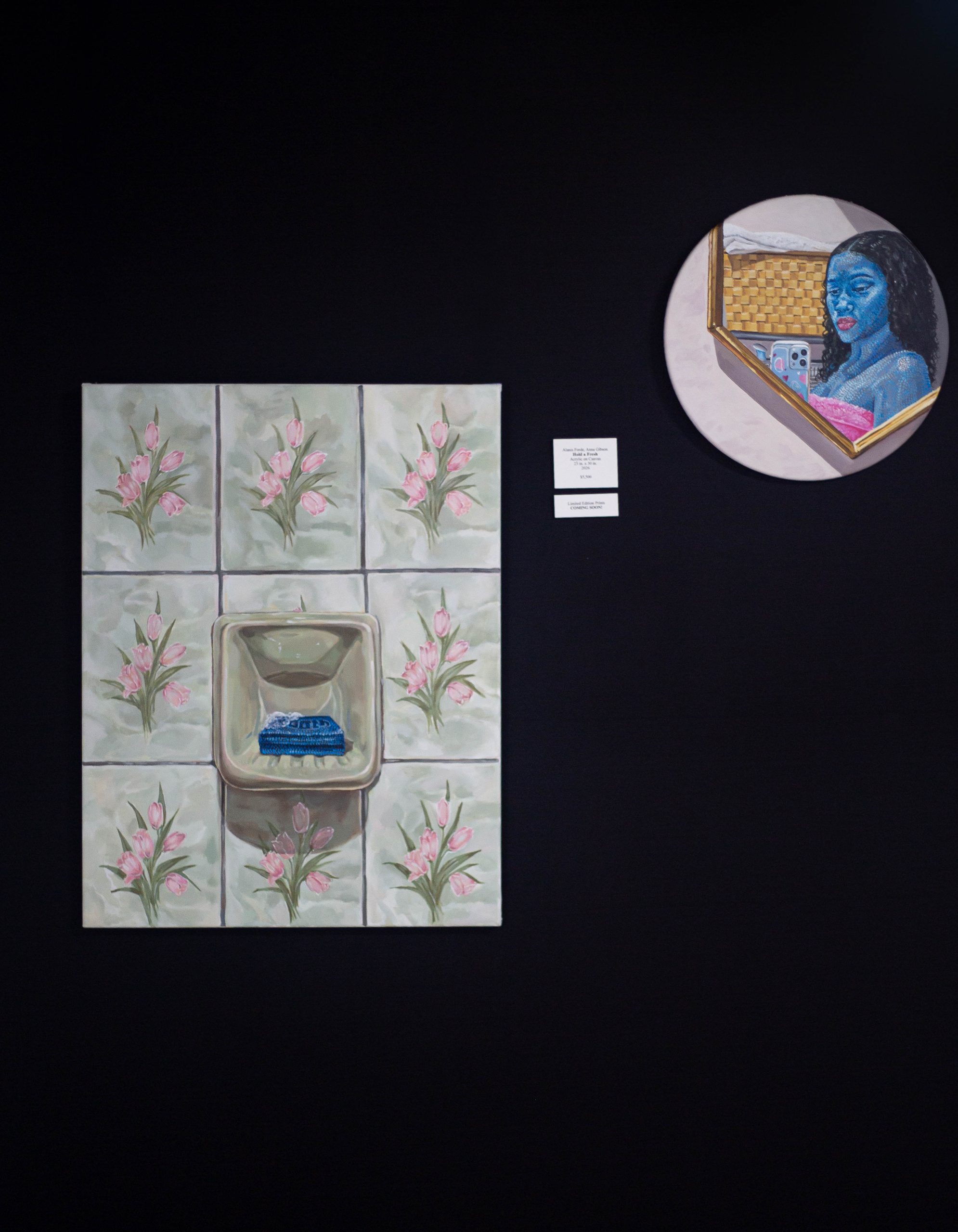
One of the smallest sections of the exhibition, the bathroom is completed with a clothes line and delicates, hanging over the window in the sunlight to dry.
THE MAIN BEDROOM
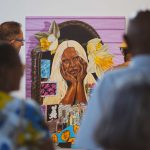
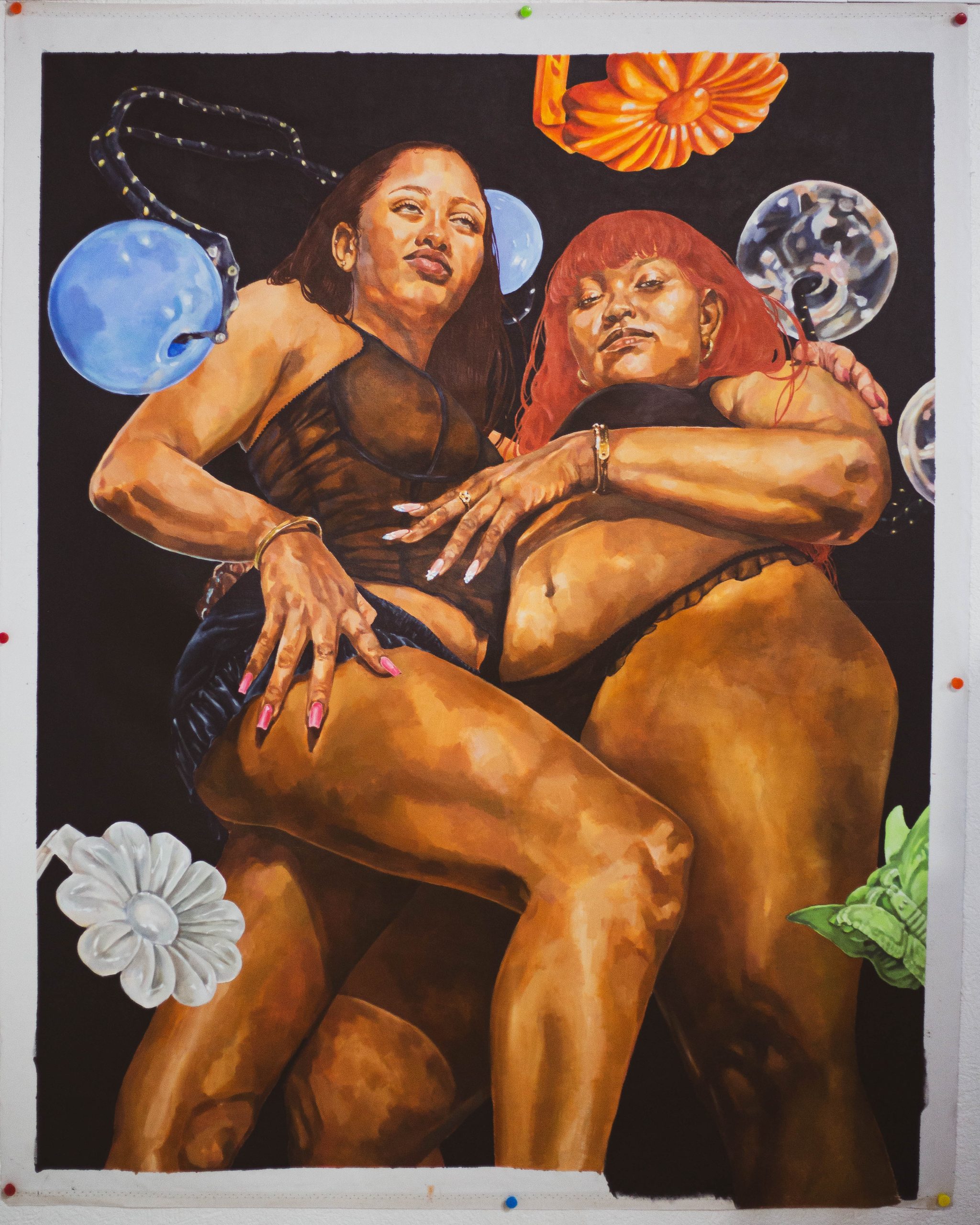
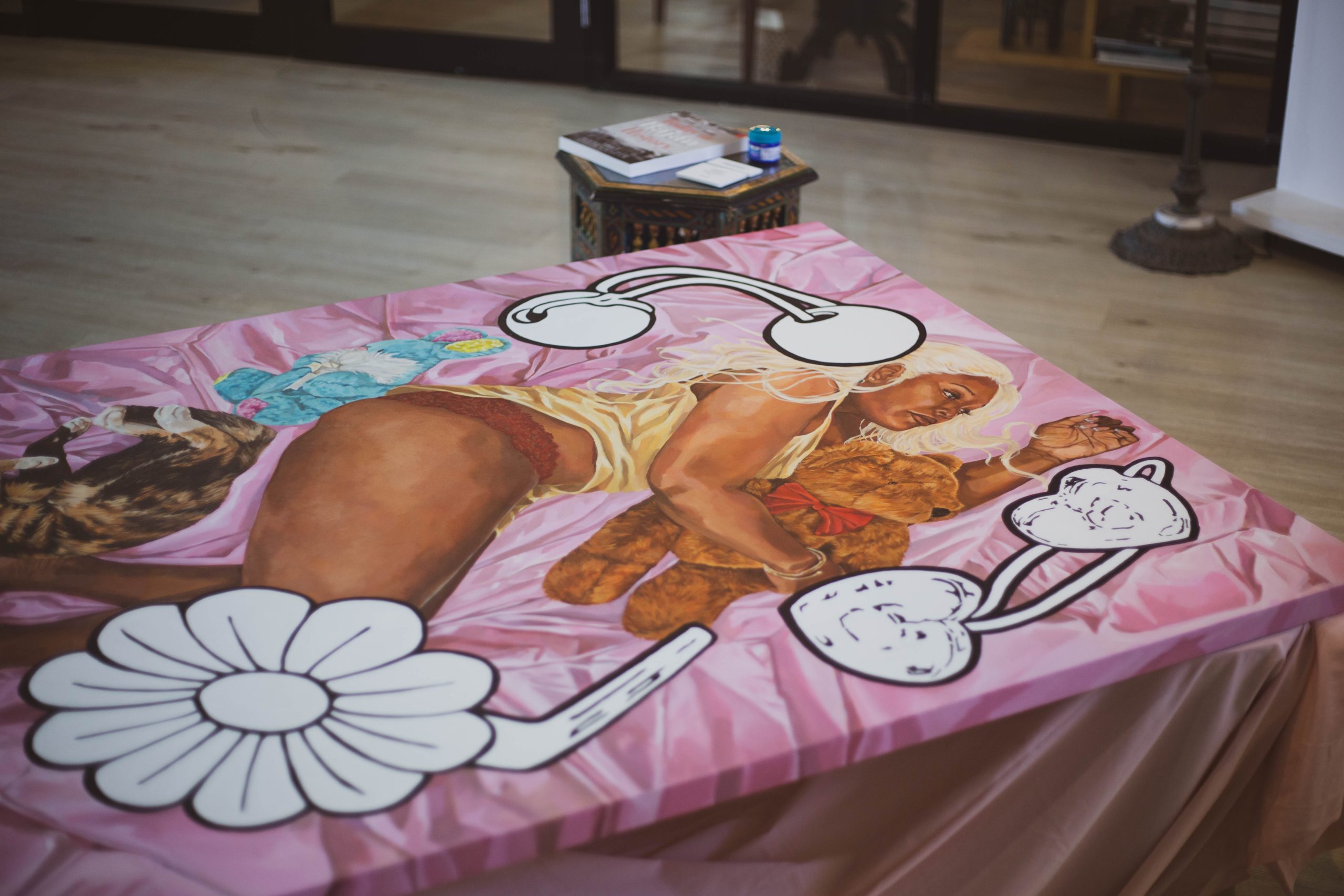
The main bedroom is complete with a vanity and a bed. One of the main pieces of this area includes 'At Home', a portrait of a woman on canvas, positioned horizontally on stands to replicate a figure lying down on a bed.
"Many of us think of chattel house painting as a particular and somewhat conservative genre; one that is often infused with a misguided nostalgia and which often appeals to visitors for whom the chattel house is simply a quaint and colourful example of the Caribbean vernacular. And it's easy to be dismissive of such nostalgia as an attempt at making the past and its irregularities more palatable or as an escape from the chaotic and dangerous world we live in. Now it is clear that the chattel house on this occasion is also subject to a certain nostalgia which is collapsed without childhood and memories of safety and family and community.
But as the title proclaims this is really an attempt at reimagining the chattel house. So as you walk through this house the artists invite you to consider what potential the chattel house and all it represents holds for us today. What should we retrieve and remodel? What can it teach us about sustainable living versatility and adaptation? What can it teach us about human relationships, family bonds, about the difference between a house and a home? Or, in different words, how can we convert the nostalgia into some form of future? Or how can the chattel house be subjected to an art of what you probably know as Sankova, the Akan concept of learning from the past to build a better future."
Opening Remarks by Dr. Therese Hadchity
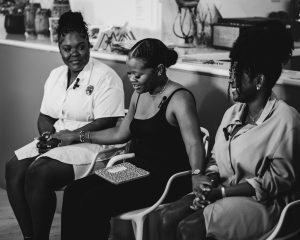
MEET THE ARTISTS - THE THREE A'S
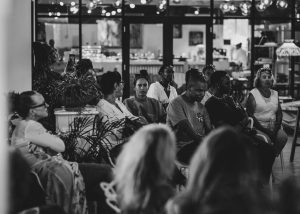
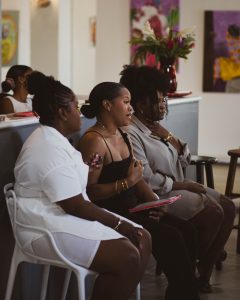
On March 21st, 2026, the ‘Meet the Artists’ event was held at the Caribbean Brushstrokes Gallery. The conversation covered many areas of the group's work, from the nature of the collective, the planning of the exhibition, and the decision to structure the show in the way it was done.
Many of the questions focused on their experiences working collectively, on how they balance individual artistic expression with shared painting, and on their methods to foster effective communication.
Audio and Transcripts are available below.
TRANSCRIPT
Contemporary Caribbean Conversations is committed to the preservation and documentation of the arts in the Caribbean. This recording is for educational purposes only.

The following is a recording of a live event where the quality of the audio varies by speaker.
If at any point the audio is unclear, please make use of the transcript below.

Speakers:

RS- Rae Skinner, AF- Alanis Forde, AW - Akilah Watts , AG - Anna Gibson

RS: Thank you so much for coming, when you hear these ladies schedules [laughs] I don’t know how they do it, but they do.  I'd like to introduce you to the Three A’s: Anna Gibson, Alanis Forde, and Akilah Watts.

RS: I'm not going to spend much time talking because I know we'll have lots of questions as they themselves. The one question I've heard since the show is up is… "How did they pull this together?" So maybe we can start there, in terms of how your ideas came about and I'm sure you'll have questions.

RS: So over to you ladies.

AF:  I guess we could do a brief introduction. My name is Alanis Forde.

AF: I am an artist and I have been doing art professionally for, I would say what, 10 years? I graduated in 2017. So I would say from then on almost 10 years.

AF: And I've known Akilah since I was four and I've known Anna since I was 16. So we have long relationships. We went to school together, primary school, secondary school, and then we all went to college together.

AF: We all met in Hatcher's class in 2012. And since then, well me and Anna sat across from each other. I already knew Akilah and then since then we've been working together.

AF: So I'll let them introduce themselves.

AG: Hi, I'm Anna Gibson. As she said, we've been working for over seven years now. And I mostly like to look at like women's bodies.

AG: I kind of explore insecurity and dive into that hemisphere. And I love painting and that's kind of where I'm at right now.

AW: Okay and I'm Akilah Watts. I'm a visual artist. My work is heavily focused on painting currently and I'm looking at examining people as an extension of our spaces.

AW: So that's why sometimes you see the skin is taken over by a lot of patterns that have fruit or vegetation or some kind of snack represented in them. Yeah, let’s just dive right into the questions.

AF: I probably should say what my work is about. Yes, my work is about examining what it means to live in paradise. A space where others escape to, or vacation.

AF: So in my work I'm trying to find my escape or my paradise. Obviously living here I don't see it in to the same lens as the tourists or the person that, you know, comes here. So I'm trying to find that third space in my work.

AF: You will see a lot of white negative floral patterns in my work as well which represents the tourists coming into our spaces, coming into our paradise. Great, yeah.

AF: So in terms of how this show came about. If you were at the opening, Rae talked about how we met her maybe a month after she opened this space and she wanted us to do something for women's month last year. But we you know schedules, it's too tight. So we said let's do it for this year.

AF: Schedules were still very tight and we ended up starting work for this show in January of this year. I would not recommend.  In terms of sketching for this show and the idea behind it. I think we always used to talk about living together.

AF: We're like what if we just live together as three women artists you know what that would be like. And for this show we would say okay three women living in a chattel house. That's the first, I think one of the first.


AW: No I think we was kind of like back and forth for a while and I think because of our schedules we had never really settled fully on it.

AF:Right.

AW: And the inception we always said we wanted to do a full, we wanted to do a full collaborative show. But again as Alanis mentioned because of our busy schedules that did not necessarily allow, there's multiple pieces within the show that either feature two or more, a.k.a all three of us on one canvas but there are a selection of pieces that's only singular.

AW: So that was I think our first goal talking to Rae about it too. It was like we don't want necessarily just pull pieces from our studio that were already created and then curate a show. That is something I feel like is regurgitated a lot in this exhibition landscape. And we wanted to build something from the ground up.

AW: Like as soon as you enter the space you're immersed into our thought process of what we were thinking for the exhibition but also… just be completely immersed in the space. So yes you know you're in a gallery space but even just having furniture and everything present transforms you or transports you into a completely different space.

AW: So for us it wasn't only important how we work, or the amount of work, but also the concept but the intentionality with which it was displayed.

AW: That's also part of the importance for it for us. So I think the Chattel House was more or less our final idea. Where it was, eureka, like that's the one that actually stuck. Not that we didn't have multiple ideas that we bounced between prior to that but I think that was the first one that it was like ‘oh that's interesting’.

AW: We actually getting to play. We actually getting to develop a concept but not only be like okay we're working towards a goal but actually have something that we're interested in doing as we're working towards it. And it doesn't necessarily feel like a chore.

AW: I think for me personally sometimes commissions or exhibitions can feel that way because the deadline is looming. And so I think having a concept like this where it is fun and you're like okay I can't wait to start the next painting. I can't wait to finish this one.

AW: I can't wait for you to touch it and inform my process so far on it. I think that's also what helped us through this entire process of it being so tight but also still enjoying the entire process.

AW:  I feel like everybody's so far over here. And I’m not looking at y'all.

AF: And we started… well I was teaching at Queens College. Akilah was doing CariFesta. Anna just was doing her fellowship.

AF: So Anna was the one on us like guys you gotta start sketching. You gotta start sketching. And I was like oh fine fine.

AF: My lunch break at school. Call me on video call. I’ve got two lessons free.

AF: And then we started sketching in November. Sending them in the group chat and said okay like this like this like this. And then I think that's when the Chattel House really took like the final stamp, "Okay this is what we're going to do".

AF: Anna wanted all pieces to be collaborative but timing definitely didn't allow for that. We started we started too late.

AG: I also feel like the things we do in our work already like the process of our work already kind of informed the idea of the Chattel House. Like you know we all had references of home and nostalgia and like you know like Akilah will use a lot of old photos. So like you get to see these spaces that we grew up in, and exist in and it just naturally kind of came to being in this Chattel House space. Like, it was a very natural like idea I feel –

AF: Yeah.

AG: –For all our work to exist in this way.

AF: And I think as we started sketching Akilah was talking about "Okay, what if we have a kitchen? What if we have a living room? What if we have…" and you know we create it that way.

AW: Yeah I am a little crazy. Honestly, my belief is ‘the answer is always no unless you ask’. So I let my ideas run wild and then I let the people that are supposed to execute my ideas tell me no.

If they don't tell me no then this is what you get. Rae was like sure, sure, we can do that. We can do that.

How about we do this? How about we do that? And then like obviously we have to compromise.

The black wall was supposed to be originally something else but I kind of glad of the compromises. It simplifies it a little bit for what it is. So I think even the compromises worked out in the long run. But it's always no if you don't ask.

AF: Yeah yeah. And Ray having movable walls also was a plus to create these separate rooms.

AF: Okay so the title Reimagined 2 underneath the galvanized roof. Our first exhibition group exhibition three of us was in 2021.

AG: Literally during the sand- the sandstorm

AW: During the pandemic and during the volcanic ash.

AF: Yeah the day of the opening. People still showed up so wow. Yeah. So we were like okay we need to do this again.

AF: We need to almost have a do-over because of what happened for the last opening. So we so we were like okay Reimagined 2. That's just you know it's part two.

AF: And then underneath the galvanized roof we were looking at the chattel house and you know the roof of those are normally galvanized right. So what does it mean to each of us? I think we when we're talking to Therese Hadchity that did our opening talk for last week for the opening of the show.

AF: She came to the studio and she asked each of us what does you know living in a chattel house or a chattel house mean to us individually. So you want to start Anna?

AG: Okay well I mean when she prompted us for that question it kind of made us regurgitate, or like, look back on our experiences with the chattel house. So like for me I lived in one when I was super young and my grandmother's house was also a chattel house and me and my cousin spent all of our summers there. So that was like a second home away from home and recently it got knocked down because of like some weird circumstances.

AG: So I've been trying to kind of recapture the moment of living in that space and like a lot of these happy moments with my cousins and moments I've been trying to recapture those, now… And also when I look back on my old home quarters we had a lot of birthdays and stuff in my old chattel house that was my normal home with my family. So like some of that like the toys and like the toys, the images, like some of these teddy bears and whatnot like it was the pictures of them in it and I'm like I still have these, but I don't remember the house that well but like I remember the toys but exisiting past that point and I think all of us related in terms of our stories of like you're moving out of this house but like all these memories still remain or you know..

AF: Yeah when she asked that question it took me back to just before I moved me and my my parents and my brothers lived in a chattel house in one small little neighborhood up until I was 11. And I remember when we moved we moved into a wall house and it felt like I was like leveling up you know as a child. Obviously I don't know my parents financial situation but it felt like ‘okay I'm moving from this poor neighborhood into a better neighborhood’.

AF: So in this work I wanted to, especially in the little girls bedroom to the left of us. The girls running around in the neighborhood with the chattel house in the back but it's not really the best quality chattel house that we see nowadays, but it definitely is like capturing my childhood playing in the street with the neighbors and playing cricket with my brothers and stuff like that. So I really wanted to capture that essence within the little girls bedroom and yeah so I think the chattel house as Anna said has a lot of nostalgia and memories and childhood just good feeling you know.

AF: So I think we wanted to really bring that to this exhibition.

AW: Yeah I think my circumstance is a little similar to Anna's in that I well I was born in the wall house so to speak. So for me I would have spent the day with my grandmother in the chattel house while my parents was at work until I was old enough to go to nursery and then obviously on the weekends and you get ready from there on Saturdays to go to church on Sundays. So for me it was just a secondary home.

AW: I never really looked at the chattel house as a symbol of poverty or lower then, especially knowing that it's one of the only houses that is a marker for culture within Barbados. So to me it doesn't it, doesn't sit as poverty for me. It is a cultural symbol and I feel like in my work well most of our work I find that we reuse and regurgitate a lot of symbols as used to represent us but we reimagine them constantly.

AW: So when you look at our work you see those elements that you've been seeing for years. You see the beach, you see the palm trees, you see the sand, you see the sun, you see the colors but something about it is fresh and new and for me that was kind of my approach to reimagining the chattel house bringing it to life but also letting it be, because there's nothing wrong with it at all as it is. So the reimagining is more or less a mindset than necessarily the actual structure of the space.

AF: The furniture that that Rae just happened to have that was so perfect. There aren't like new modern pieces, so they were perfect in capturing something as we said about our childhood. For example the kitchen you wanted the tablecloth to have the plastic right those kind of things right those kind of things that maybe Akilah could have seen in her grandmother's house or me and Anna could have seen in our childhood homes.

AW: Yeah it was something nice about it not being necessarily put on as performative but letting it just be like the way how all of us are in here now just being ourselves I feel like sometimes imagery is put on in such a way that it needs to be performative. Like these symbols that are held so highly as cultural markers that either they stand the test of time or they sit as relics and for me I just felt that the chattel house just is.

AW: It's beautiful as it is. It stands the test of time. It is what it is.

AF: I think it creates a nice contrast to the work that we are creating that reimagines something that is already is. So it's like a conversation happening between the installation elements that we applied with along with the work that we created. So I think that was very important for us.

AF: So another question that Therese asked us during the studio visit was when we collab on a piece our work changes. Is that going to be a problem for us like okay my work doesn't read like this anymore because Anna puts her hand on it you know was that a challenge for us as you were working?

AG: No.

AF: I mean to be fair Anna.

AG: I mean

AF: To be fair

AG: I mean I feel like it was not as hard. I just felt like at some point I felt like maybe I was getting a little lost in the theme. But it kind of pulled me out of my comfort zone because I mainly look at the body, and like you know I focus on my girls and the expansion of my particular universe.

AG: So it also kind of was leading me to where I wanted to be because I was also looking at the destruction of my grandmother's house and I had photographed it and stuff before then and I was looking to memorialize that somehow within my work and using that as my form of nostalgia an escape.

AG: So I was looking at ways to add that in so like doing this show with them kind of helped me expand on where exactly I want to go with it. But I mean I'm still figuring it out but this helped lead me to that path with you know with their help as well.

AW: Which kind of touches on a point that I made earlier in terms of the concept of the show being fun. Like it not feeling like a chore. I think it almost felt like a mini residency where it's like we've been taken.

AW: We're still in our studio but we've been taken out of our comfort zone so to speak. We're accustomed to working together anyways so it wasn't necessarily a hardship in terms of sharing space on a canvas so to speak. So to me the question, when Therese asked it, I was like no we don't really have a problem.

AW: I think the question you asked we didn't have a problem with sharing space or challenges with relinquishing control because I think all of our work kind of touches on nostalgia and paradise and all these different aspects of living life as a female within this Caribbean space. But our work is already so strong image wise that once you see if you know it you're able to recognize it. And so I feel like it just informed something new while still keeping its concepts true.

AF: You don't think our individual concept got lost?

AW: No I don't think so. Especially since it's not necessarily like the piece is standing on its own where it's like okay now I need to just judge it for what it is.

AW: It's in a setting where it's informed by everything around it and there's either pieces that are singular like only one of us have done it. All three of us have touched it. Two of us have touched it.

AW: So I think there's other context going on within this space to help inform each individual piece. I think it could have been a struggle if it was like okay you are now setting up an Instagram. It's showing up on me and you account.

AW: Me you and Anna account. And if it was like okay so who do what? Now this time you don't have outside context to kind of help you navigate each individual piece.

AF: I want to go back a little bit to when we first started working. I have a baby so I haven't been able to get to the studio as much as Akilah and Anna. So I remember Rae asked me to paint some stools for the cafe.

AF: So I was delivering them and that was the first time I got to the studio. I'm going downstairs now. I have started the first one that I did was one in the living room with me like laying back.

AF: So ironic. And I was just working in the little corner taking me forever. And I got downstairs.

AF: Akilah has three done. Anna has almost two done. And I cried.

AF: I actually cried on the way home. I did. I didn't tell you but I cried.

AF: I was like I can't get this done. I don't know. I felt like I wasn't going to get my part of the because it's a collaborative show.

AF: So I was like I'm going to let them down. So I remember my mother-in-law my sister-in-law was like no. We are going to keep Press your son for you from seven in the morning to seven at night. And I was able to come to the studio a couple days a week. And I was able to work at home on Sundays. And I would not have been able to.

AF: I think seeing Akilah work so hard for this show.

AG: Yeah.

AF: Akilah did the most pieces for this show as well. And even down to the day before she did eight small little pieces. So seeing how Akilah worked really put a fire under me like I just want to thank you for that. But yeah. And we started at the end of January and we got this done all the way up to March and yeah.

AW: But that's the thing.

AW: That's where I was going to jump in on that story. I've been like you crediting your mother-in-law. Before you even credit me and Anna because you messaged and you confided in us that you was like I'm not sure if I can get that done.

AW: And I was like girl you can get it done. Take it one piece at a time. I literally brought my nephew's crib downstairs.

AW: I was like even if you got bring that baby to the studio you can get it done. If you need to be on video call with us at home because you need sometimes that's the thing too. Getting out of your own space because when you're home you're comfortable because all of us used to work at home at some point in time.

AW: When you're home in the studio sometimes you just be like the bed right there, the snacks right there, the TV right there. I ain't working. And then a baby on top of that. Well I definitely ain't working.

AG: But you also she also gives herself a really hard time because she's a fast painter. Yeah you know like usually her production time is like in no time but even harder.

AW: So for us it was more getting her out of her head space. Obviously you're in a different space that you're usually at to be able to produce the amount that you're able to produce. So give yourself some slack. Give yourself some credit.
We have the time. And if it's a case where you only have to paint certain parts of the painting then so be it. We will take the slack on that.

AW: I think having worked together for many years, this pretty much the same 10 years that I mentioned earlier. We've worked on mural projects but to a certain extent we have the groundwork to be able to do the basic stuff. If you had a painting and you couldn't do the background we could have done it.

AW: So that's what we were telling her like "Remove yourself from the stressful state because you're not necessarily doing it alone". So the collaboration process was not only in painting but in supporting each other.

AF: But this is the first work that I have created since giving birth. So to even pick back up the paintbrush. If I don't have this show I probably wouldn't have even have painted to this day yeah

AW: But that was obligation before you know but imagine but yes okay Oddly emotional Okay so let's talk about some individual some collaborative pieces we did.

The first collab.

AW: Wait should we ask them if they could tell? I mean everyone should have seen the source. They all should have seen the title.

AW: Never mind.

AF: The first one was the bunch of ackees. Akilah sent the photo in the group chat and I was like that looks so amazing. And I was like wait why is the hand missing?

AF: She was like you’ve got to do the hand. I was like okay.

AF: So that was the first one that we did and then all the way down to the last one was.
AW: I think technically the first piece is the last one that we would have done is the opening. The first one you see when you walk through the door. It has a like all three of us have touched it in some way or form. And I would have started it first because I would have it well the part I had to do it was underneath so it's the easiest for me to start but also I had the time to be able to start it first.

AF: Yeah I think you were pretty much done at that point what you had to do. Yeah um what was your what's your favorite collab? And they don't have to be one that you worked on.

AW: Why’d you say that now I’m going to sound bad if I pick one that I worked on. I’m going to say the vanity. Like so that's the one in the second bedroom that is on the wall behind the bed, that's my favorite.

AF: How about you Anna? Okay. I already know what mine is.

AW: Well then you go you put she on the spot let she think.

ANNA Okay. I think I like the tv. The tv?

Oh I love it.

AF: Well I think my favorite–

AUDIENCE: How do you go about starting? Do you say okay well I'm going to do the face and somebody else work on another aspect? In terms of line and composition at what point do you begin the collaboration?

AW: I think the collaborative process was the entire thing so even through the sketching process we were talking back and forth yes about it even though you sent sketches I sent sketches Anna sent sketches. Then I was like Anna could I could put something for that.

AF: Oh right.

AW: Anna was like to be honest I sketched this and I did thinking about you so even through that entire process.

AF: All Anna's sketches was um having the collaborative aspect in mind whereas I was creating some individual and collaborative and I don't know how your process was but in terms of who we know gonna work on what it goes both ways.

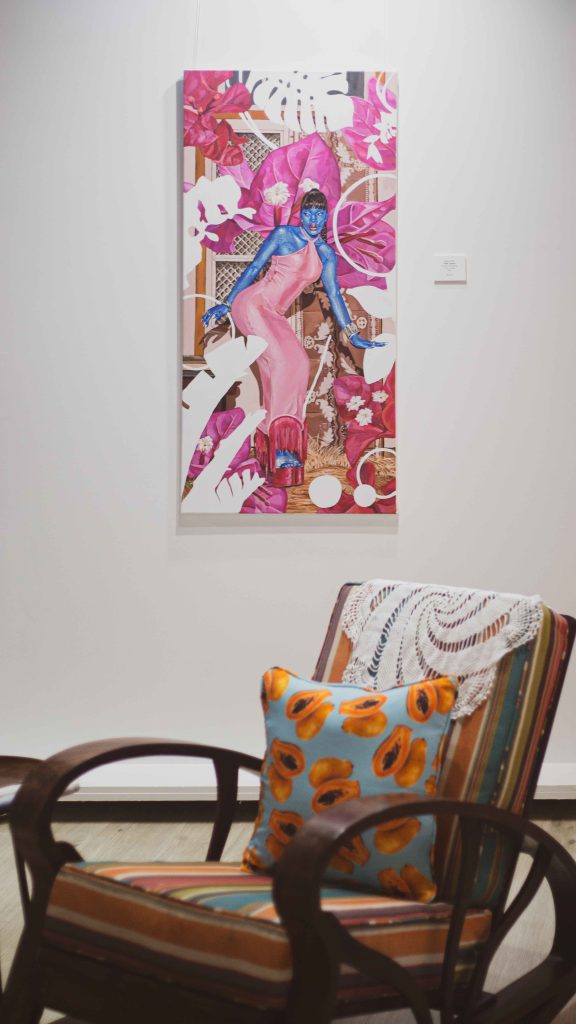
AF: You know it from the sketch and then for example the pink lady, that was going to be all me but I was like ‘I think I want Anna's bows on her chest and I think I want Akilah to do the background’ so that's how it goes sometimes.

AUDIENCE: So you're all interwoven. I wonder how having been together all the time from community college coming up you must be influencing each other in some ways. You must be collaborating in some way.

AG: Maybe subconsciously.

AF: Maybe subconsciously because as Akila said we've been girls together too so I mean we work so much together.

AG: Yeah like we seem different but it's all interwoven. Also we're from the Caribbean and Barbados.

AUDIENCE: I've enjoyed myself so far but what I wanted to ask is how do you know when to stop? So for example you used the pink one with the bows that I can see quite clearly here and you said you wanted your colleagues bows. So how do you know?

AUDIENCE: Is it too much? Is it not too much? Don't do another stroke.

AG: Well we play around with editing and like drawing but we do sketches, also digital sketches. Sometimes we are there together but like any moment we just do it quick.

AW: Sometimes you just know. But sometimes you just know because I think that's why the vanity is my favorite because we more or less have a sketch. The thing with our works we play a lot with collage even if the final product is a painting and you could look at it and okay these things you know are not supposed to be together but for some reason they mend.
And for  the Vanity it was a hard one because we were mending almost three or four images so that shadows from one needed to inform the other. This collage piece is also a headache for me because I'm doing more or less the shutters. I'm doing the base of the structure and I am working off of three images and so I feel like I lost my train of thought.

AF: When we know when to stop.

AW: Oh right and so the vanity we would have not been wanting to use the stuff that was in the original vanity. We wanted to obviously add elements that would give more context to the show and to Barbados in general and so I feel like the postcards that are on the mirror are like literally the last thing that we decided upon.

AW: Lke the sketch was done months previously, it was already drawn out, it was already started painting, and it's only in like the final process that like that, was also a decision that's now being informed by all of us being in the space, like what other work that we plan to put in the same room, maybe those things need to be tied back in with this piece.

AW: So for me that was also important having like little nuggets or little easter eggs in the rooms that are in either other pieces within the room or in other spaces completely in the gallery.

AW: So like you'll see like a common theme in terms of our prints or our words or our backgrounds displayed in each room, even though when you look at the work you can place it in a specific corner, if that makes sense.

AUDIENCE: Are there any intuitive elements to the process?

AG: Some were intuitive, but like I think this painting here with Alanis' heads, she was like, she had, she wanted to stick them, stick them on these flowers, and then I was like, you know, let me stitch them. You can't really see it that good, but let me add to this, like so there were a few choices like that, but I think the way we process is like, we kind of just, it was just easier for us to have it laid it out, how we want.

AF: Especially because of the time.

AW: Yeah, I think a lot of intuition happens before the planning stage for us, and obviously that's not like a set in stone thing, because the same thing I was mentioning about the vanity, but we are opening up ourselves to the possibility for change at any stage, because even like we change the color on a whim.

AW: Yes we do a sketch, or sometimes we do a sketch, and it's like, okay this looks good, I could start from this, and then you actually get to the canvas now, it's like I'm really too sure about this, I ain't too sure about that, what y'all think about this, so I think for the most part, yes we had a general plan, because we had the installation, or the interactive portion, or the immersive portion of the exhibition in mind, but I think we were open to the intuition through the entire process.

AUDIENCE: Is it always as agreeable as you present it?

AW: No, no it's not, no it's not, but no it's not, no it's not, no it's not.

AW:  I think for us, sometimes we, I think when Anna was– the vanity clearly is the talk of the town today– because when Anna started, it was a completely different girl, but she was talking about wanting it to inform, or be related to other things within the room, so she took a photo of my face. And when she started it, I was just like, that is scary, like you know how paintings go through processes, where it goes through the ugly phase, and so– it was never ugly when we started, but it was reminding me of ‘Scream’, it reminded me of like the movie ‘Us’, that's it right, that's it, like where it's like you almost have like an other self, that is almost like this darker being.

AW: And so we are open to that kind of criticism from each other, or that kind of like input from each other, where it's like, I ain't really think that working. Yeah, but you say it, you say it in a nice way, it's like it looks great, like it looks great, we know you could paint, you know what I mean,

AF: but what I do is, I don't say anything, until it works, you know, it gets worked on some more, right, so obviously as an artist, maybe when it starts, it's like, I'm looking a little shaky or whatever, but you know, I worked with them long enough to know that these are very skilled, you know, so no worries.

I think working with them so long, and coming from like almost like children to adults, I don't think we really got like, yeah, yeah, yeah,

AW: Like she was mentioning in terms of the collaborative portion, instead of the competitive portion, it's something that Alanis was saying for years, she don't say a lot now, I don't know if you remember what I was going to say, but : Rising, Rising tides, raises all ships.

WF: What me?

AW: Yes, girl, for years, no, she don't remember it at all,

AF: no, no, no, It was be in competition with yourself…
AW: No it was the ships thing.

AF:  I never said that,

AG: I don't know it

AW: But basically, this idea of not thinking that your successes are competing with your friends or your colleagues, but that it is bettering the cultural or the artistic landscape, like in Barbados everybody would rise together, its not a competition.

AW: yeah, I mean, we had that moment, for sure, yeah, and then when Alanis draw, or I draw out the portions. When Alanis start the sketch, and she's who is drawing it out, and that, that flower ain't clean, that butterfly ain't clean, Anna gon be  like, ‘She could have let me draw that out.’

AW: Especially when you're doing flat vector images, white while it seems very, like, clean and pure, that is one of the hardest things to keep clean, that you have to layer, so I think that probably, like, the biggest challenge we have, yeah, me and Anna, yeah, and I said, I want to draw this, so you, how do you say, Anna's draws this out,

AF:  I called you, yeah, you were like, yeah,

AG: I tried to explain, but it was fine

AUDIENCE: I want to ask, is there an outside person, that all three of y'all trust, that if there was a vote, that y'all have to do, like, one, like, move in, move out, that you all go, and trust to say, this person will make the final decision; and then the half of the question remaining is, if you were to do another show together, what would that show be called?

AW: First question, no, we don't have nobody, there's three of us, so usually it's like, if there's two people, oh well. So we’re very much, like, I think if its a decision where, okay, so say we post something to the table, Anna likes it,  I don't like it, Alanis is now the third person to make that decision.

If Alanis, if she didn't really care, she's like, I could do either or, and so then, when it’s left up to Alanis, that's when the conversation is the longest. Because usually, she's like, I can see the merit in both, and that's not to say that me and Anna can't, but usually, that's how the discussion would start, then we would kind of lay out the pros and cons of what we think, and then sometimes, I might change my mind, like, ‘Anna, you know what, you right’. I know seeing what you've seen, sometimes it's just a matter of just hearing it out, yeah, so, but for the most part, we handle that in house

AF: And what the third show, gonna be called?

AW: Reimagined 3?

AG: Yeah, it's the hardest part, and it's usually informed by the work. So I really can’t say exactly, probably Reimagined 3.

AW: That’s what I just said too.

AW: I mean, choosing Reimagined 2, to me, was a specific choice, because the subheading after Reimagined is more or less what the show is about, because the first show was ‘Unspoken bodies and spaces’, that was pulling work from our studios, that was already done, but that was, again, our work was informing each other, but still in its respective contexts, so I feel like that hadn't kind of worked.

AW: So for us, it was almost like getting to go again, trying something from scratch, while still reimagining that entire process that we would have wanted to do, the frame that's on the main piece was also featured on the first collaborative piece that we did in that show as well, so it’s just kind of bringing things for a circle, even Therese  doing our opening descriptions and whatever, she was who did our critique for the first one. So they're just little touches like that, that will kind of bring you back as a nod to Reimagined 1, with stuff that we were thinking about as well, so who knows, maybe Reimagined 3, maybe in the next five years, I don't know.

AF: Did we have any fights?

AF: And the tension. The most tension was probably if somebody was taking too long on a piece, and you know you had to collaborate on it after. It'd be silent, you know me, but you gonna feel it.

AG: I didn't feel the tension though.

AW: You don't feel the tension? You tell me, you feel tension from me.

AG: Oh, because you're the first one. But I wasn't studying it that hard. Yeah, but it was more not tension, but just the pressure

AW: But again, that's in sharing the canvas and sharing the space, so it's a case where it's like I have the majority to do on the painting, and I also didn't have a lot more time to be sure y'all can see paint on my skin right now, because me and Anna are already on to another project that is very time sensitive, and so for me it was just like, I need to get this done.

AW: The show is opening in a couple of days, I am the head of a department that is on another project, so can I please, please, please, but then I also know who my friend is, and I want to give her the space to be able to create freely and not give her that, so then it's like okay, I'm gonna sit back, I'm gonna keep my mouth shut, and I'm gonna do other work that I also need to do while I wait for her to finish in her own time period. So no tension, that's what we're doing instead of tension, no pressure, but maybe a little tension or the other way around. She pressures herself.

AF: Also, Anna works the slowest out of all of us, which is so funny because she works the biggest.

[The question here is structured around satisfaction and departure, asking whether the artists are still happy to be working in the medium and the topic and the style that they are, or whether they've reached a point where they're ready to move on from the style of work that they are currently doing and explore something new.]

AG: I feel like my work is still growing from this, as well, you're constantly changing, shifting, and I'm sure all of them will agree that something new will always come up, but this is probably still within the grown work I'll have to create going forward, yeah.

AF: Yeah, so this work is very new because I created work with a specific theme and idea in mind. Okay, I have to do two paintings for the bathroom, what would that look like? I have a selfie of me in a mirror from where I used to live.

AF: Okay, what if I do the canvas a circle because that could, you know, be a mirror, right? Anna did the tiles. I was like, okay, she had this picture in her phone of her tiles at home, but it's soap within the soap holder, I was like, okay, blue soap.

AF: My people are blue. I could dot the soap blue, you know, so that's how we worked for this particular show. So, in terms of what we create next and the point of departure after this, who knows, but I think we're just approaching what Barbados is from the most honest and real perspective we can as being locals, right?

AF: Barbados is marketed and mass-produced in a certain light and a certain image to attract the tourists, but that is not the same reality for us that live here. For example, I think the new Hotel Indigo?  When that was being built, the traffic, the, oh,’ they're blocking out so much light that used to come here just’, you know, right? So, the tourists will go there and say, oh, this new beautiful place, but us living there is like, wow, I remember what it was, you know, oh, no, well, I haven't been, so I don't know. It's not finished?

AW: Yeah, but to get back to the question at hand, I don't think reimagined is the word because I don't think that it is your duty to reimagine something that is not of, that is of someone else's culture. I wouldn't expect you to think when I go into an exhibition somewhere else that has cultural influence from other places for me to have… I don't know what's the word I want to say necessarily, but not knowledge, but the cultural connection could be the word, but also like, I don't want to say audacity, but I want you to think of reimagined as more experience.

AW: The reimagining is to be done by the people that are experiencing each other from the ground up. You're not being introduced to this imagery, so it's almost like you're digesting a new definition that somebody else from that space that has already imagined it is now reimagining. I don't think it is something for you to reimagine, but for you to now, experience, or now, imagine. If that makes sense? Does that make sense?

AF: Like maybe when you pick up a novel for the first time and you delve into a new world.

AW: You're experiencing it. You're not necessarily reimagining or trying to reinterpret the author's words. You're now trying to experience it for what it is from the people. The best way to learn about space is from the people that are living within that space, the culture, identity, those kind of things.

AUDIENCE: How do you as an artist feel about having a prerequisite theme, as opposed to working openly and determining the themes and the categories of the work afterwards?

AG: I like both.

AUDIENCE: You like both?

AG: Yeah. No, because sometimes the theme helps to inform the effect. So I like that, and then I also like just being able to do something quickly and then growing from that.

AG: But I find most of the time when I do that, at least for me, sometimes I don't end up getting it resolved.

AUDIENCE: So you don't feel at all restricted by the imposition?

AG: Well, yes, if it imposes on me, but if it's my own theme, then I got all the freedom.

AW: I think my interpretation of the question, I think we usually approach it in the latter, in terms of we just create work because we have a concept and we have something to say, and whatever develops from that concept onto that canvas, now that it's going to be decided where it goes, like you were saying.

AUDIENCE: I think I asked the question badly

AW: No, no, you didn't, because this is where I got touched on the first part.

AUDIENCE: It's how you feel about themes being given.

AW: Oh, I don't like themes being given. I think majority of the time when themes are given, sometimes they're, not only are they stifling, but majority of the time they are so vast, I could just pick something up and shoot it and just drop it in. So I don't really think of them, fair enough.

AW: Okay. Because on the other point, what I think Anna was trying to get at in terms of a theme that we impose on ourselves, I think for us, it wasn't necessarily thinking about it in a thematic way, like I'm going to give a theme and I'm going to create work. But for us, the theme is also in creating the space and making it immersive.

AW: Because that's also something we've talked about for years. When we wanted to start a gift shop with Alanis wanting to do a whole immersive gully scene, I don't know if she even remembers this,  and Anna wants to do sculptural pieces. So for us, it's definitely the tip of the iceberg of where exhibition, immersion could get for us.

AW: Like you could be, this is the tip of the iceberg. That's what I'm saying. The tip, as in like, you're now starting.

AW: No, you call it the tip of the iceberg and that's the first thing you see when it’s floating?
AUDIENCE: How should viewers be interpreting your work as a collective or as individuals?

AW: I think this touches back on what we were talking about in terms of the ego and the collaboration process and relinquishing that control. And so for me, I've loved everything that you've said about it because I always say that art is a visual language. We also know that visual art is a visual language.

AW: And the same thing with language. If you read a poem in English and you read it in Spanish, it's not going to be translated the exact same. I think the good thing about collaborative pieces and the way that you approach exhibitions where you could see all of our elements, because you did come to me during the show, I was like, well, I see you here, I see Anna here, I see Alanis here.

AW: I can't even tell who did what. I think the good thing about that is it forces you to revisit because now it tickles your brain to be like, there's something that I don't understand and I'm trying to figure out. So it kind of keeps you entrenched within the space to have to view more, to have to learn more.

AW: So I don't think that we are necessarily going about it with like, you have to see a piece, you have to see me here, you have to see Anna here, you have to see Alanis here. We are relinquishing that control for it to become something on its own.

AF: Yeah, yeah.

AUDIENCE I found that when I saw the work, I could see of each piece individual artists.

AW: But that's what I was going to say about the language.

AUDIENCE: The fact that we're so trained to believe that we have to be against each other, that we're all separate. And I love this show because it became very collaborative, that nobody was afraid to touch another person's work. It was all okay. And I love the whole idea of the art community lifting each other up. And to me, that's what I appreciated about the show.

I felt that it was three artists really sort of, they're individual, but they're all collective, lifting each other up. I really loved it. There's a very distinctive quality there.

AW: Which is why I was mentioning about language. Because once you understand it, you can see it. And if you don't understand it, you have the possibility to learn it more.

AW: So the more, like, again, context, like once you know about a particular space, you're able to read it. I think we're supposed to put this show in a completely different space. The people that are experiencing it, that have never been to Barbados, are going to experience it differently.

AW: If they've never visited here, they don't have to put themselves in a position to know, learn, and grasp a new culture. It is all about language. And the more you know, the more you're able to pull out different symbols, different ideologies.

AW: And so again, like you're saying, you're able to see our work in all those things. But for somebody else, there will be no learning that. So I think that's the fun about it. Everybody's going to experience it in their own way.

AUDIENCE: What comes up to me is, who chose that? Death of the ego. And this whole idea of the artist and their ego, and their belief that if someone comes and buys your piece, then they're doing all the other artists' something. Your work as creative expression is all about energy. You will speak to different people.

AUDIENCE: So the three of you working together, you're pulling together all elements. You can see the harmony, you can see the strength in each of the artists. But coming together, it speaks a language of mutual respect.

AUDIENCE: And that whole idea of ego goes out the window.

AW: Yeah, I think our ego is more set for this show in the collective aspect of it coming off the way we want it to be. That was it for us.

AW: The ego is more rooted in, oh my goodness, it doesn't look how we want it to look. The concept is not coming through. It's not reading throug

AW: It's not in individual pieces. It's again, in the collective. The ego is a together thing. If one thing was slacking, then it's like everything's slacking.

AUDIENCE: Now, here you are again with another collab, and time has passed. So I just want to ask, what kind of learning curve have you experienced through this new collaboration?

AW: I think relinquishing control. Relinquishing control. I think, like, Akyem would have said we’re making it sound like all rosy, but again, like Rae would have mentioned, mural is already from the inception, something that is not necessarily our individual conceptual works trying to come together on one canvas, and so I think that's the difference. But also we've been working together long enough that we are still looking for the betterment of each other. That is not that much of a hardship. I think it is just, for me, it was more fun than challenging.

AW: They forced us into, like I would have said earlier, a residency kind of mindset where... Yes, the fun. Because, I mean, we love art.

AW: We love creating, but I think that's one of the reasons I love residency. I used to do one once a year for almost like three to five years span, and then I stopped doing them, and so this is the first time I feel like I've been able to experience that feeling at home. Because you get comfortable within the studio and how you work, when you work, you have to get work done, and so to be able to create work that you love with your friends and then also still feel like you in this space of removing yourself from that comfort zone has been a lot interesting for me.

AW: I think the fun and the removing yourself from the comfort zone probably.

AF: Yeah, I would say my biggest challenge is now being a mother. Yeah, being an artist, while, having a young child is... Yeah. I'm thinking,  okay, I can sit him in my lap. Nope. He wants to grab everything. So that was the biggest challenge for me, and I think that one night that I messaged, and it was like, guys, I don't think I can do this.

I don't think I can hold up my end of the bargain. And so that was like, if you need me to call you, if you need me, you know. So I don't think I needed to give up any type of control in terms of working with them, because we worked together so long.

AF: I trust them wholeheartedly. It was just, the biggest challenge for me is not being a mother and creating work through that new title.

AG: I mean, working with them, I feel like it rejuvenate my practice. Do you know what I mean?
I mean, they’re always there, but actually integrating them into the way I work, it just made me feel more excited to keep going, to continue. Yeah, yeah, yeah.

[The Statement here comes from Barbadian artist Ras Akyem-I Ramsay. He praises the three As’s for the relionship they’ve built over the last few years as well as their ability to compromise, stating that its not something that comes easily to him due to the nature of his work. He describes it as being unable to surrender a facet.]

AW: Which is crazy to me, because you taught us for one year, and I feel like that lesson that you taught us on the idea of vessels, like is a cup really a cup or a bowl, or like those kind of things is the ideas of relinquishing control. So even though you only hear…

AUDIENCE : No, it's imposing.

AW: Imposing control. Yeah, so even though we only had you for a year, I feel like it was impactful enough that even afterwards and whatever else happened, not getting to it. You made an impact.

AF: Yeah, thank you.

AW: You have more questions?

RS: Any more questions?

RS: I am sure the ladies are willing to hang around a bit and take a look through the exhibition or any questions you may want to ask. But this has been the biggest artist talk. I think we should give these three ladies a real round of applause.

AW: I guess I could do it. I just want to say thank you. I appreciate all the well wishes and all the questions because I think questions is the thing that I appreciate the most, even more than the well wishes, because they help to develop more things.

AW: They help to develop our thought and thinking of what more could be developed. So I just appreciate all of y'all taking the time to come out today to sit with us, listen to us first things first, but also to give us your questions. Tell us what you saw within our work.

AW: Let us know what you felt being in this space because it was very intentional, all the things that we put in here and all the work that we did. So it's great to hear that it was read and received the way we wanted. We worked very hard.

AF:  Also, I want to say thank you to two of these amazing women. I wouldn't be able to have done this without you. So thank you very much.

AF:Thank you to Rae for allowing us to have this.
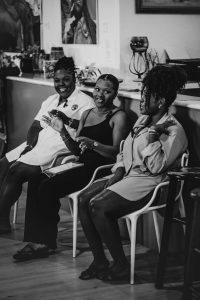
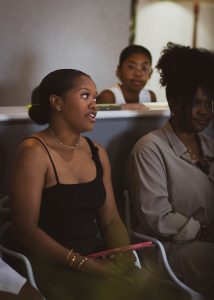
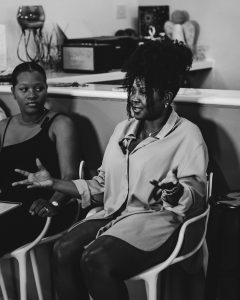
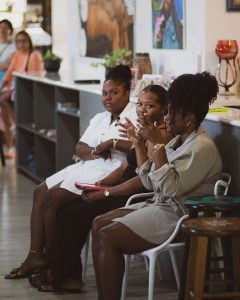
Documentation by Giselle Walker. Photography courtesy of Giselle Walker