Physical Address
304 North Cardinal St.
Dorchester Center, MA 02124
Physical Address
304 North Cardinal St.
Dorchester Center, MA 02124

CONJURING
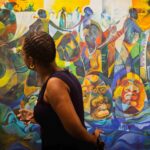
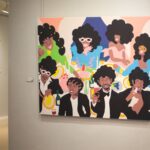
'Conjuring' was an exhibition of painted works that filled the gallery of Caribbean Brushstrokes with a unique kind of energy.
Featuring the work of Barbadian artist, Ras Akyem-I Ramsay and Trinidadian artist, Shawn Peters, the exhibition delved into the long-standing challenges silently gnawing away at the Caribbean community to date.
Yet, though the issues being confronted were quite grounded – gun violence, mortality, the continued effects of the slave trade on the psyche of those who have lived past it – the approach with which these topics were handled tended to lean more towards the spiritual.
Both Peters and Ramsay, through the semi-abstract nature of their work, appeared to be concerned, not only with these tangible elements, but also with the unknown ways that these societal issues have influenced the collective Caribbean subconscious and, inevitably, the spiritual connection to the self.
Peters and Ramsay brought these questions to the forefront of our minds using the language of the metaphor. In Peter's work, this sometimes took the form of the mask, in Ramsay’s work, the ‘yam-headed’ figure or the man who refuses wisdom.
Colour, within this exhibition, was a clear extension of their joint ability to build worlds on canvas. Much of the work of embedding that spiritual perspective is done through colour and contrast (or, in particular cases, the lack thereof). The vibrant and unique choices in palette only lent themselves further to that idea of the surreal, suggesting a world that ebbed and flowed with a movement not unlike a musical composition.


“To conjure is to practice a form of magic– an alchemy of bringing images to mind and making the intangible real. It is the process of elevating artistry beyond skill, transforming base materials into art as a vital vessel for sharing human experiences. “ Kenwyn Crichlow
The exhibition opened to the public on December 3rd 2025, to great success, with a well-attended opening reception that featured opening remarks by Trinidadian artist and educator Kenwyn Crichlow.
On Friday, December 5th, 2025, the proceedings continued with a short presentation by Crichlow on Abstract art and the Caribbean.
The presentation was designed to prime the listener for the work they were about to view and was meant to encourage visitors to approach the work perhaps more critically than on an initial viewing.
Audio and transcripts available below.
Contemporary Caribbean Conversations is committed to the preservation and documentation of the arts in the Caribbean. This recording and subsequent transcript is for educational purposes only.
KC Good-Good evening, ladies and gentlemen. Good evening. Good evening !
Crowd Good Evening
KC Yes, yes. Because I want this evening's presentation to really be a conversation. And it's not a lecture. We did that on Wednesday. Today, this evening, I would really like to get some feedback about the topics that we've selected. And we're going to have a discussion with the exhibiting artists at some time in this discussion.
KC So I'm keeping it really very open-ended and flexible. I know at the first instance, I want to talk about abstraction and art, because that's a concern or a subject that creates a lot of uncertainty and insecurity. I just want to put that into context and then talk a little bit about the arts of the Caribbean. And then we will talk about the arts and the artists here. All right?
KC So the thing about it, what I'd like to emphasize at the beginning, if there's anything that I say or any question that arises in your own mind as we're progressing, just raise your hand and there's a mic somewhere above, and we could have a conversation rather than a...
KC So there'll be a dialogue rather than a lecture. So I hope that's okay with you. Is that all right? Okay. Wonderful.
KC I want to start with a little definition of terms, for those of you who do the academic tradition, you know that you have to start off with the academic aspect, list out some of the definitions. And I want to talk about, first of all, abstraction. What is it? All right?
KC I should ask you first, so let me get a sense of, what do you think the term abstraction and art means? Do you have an idea? Anybody would like to venture what they think it might be? It doesn't have to be right or wrong or whatever.
KC It could be... I wish, once I have something as a starting point, that we could go forward with.
KC All right. Okay. It is primarily the fundamental language of vision. We see and we make lines. We see and we make shapes. We see and we make textures. All right? It is the fundamentals, the things that we were born with in our eyes. If I were a chef, I would tell you it would be taste. It would tell you that, oh, this is bitterness and this is sweetness.
KC This is sharp. This is dull. This is bland. If I were a musician, I would tell you this is do, re, mi. And this is [claps] rhythm and so on. The absolute fundamentals of our practice as artists. In the world of expression as we know it, abstraction operates at a polar extreme of realism. So, and I have a little illustration I wanted to show you. So, at one end you have abstraction and the other end you have realism.
KC And as artists, we negotiate this line with various elements, line, shape, color, and we use the principles. The principles are really the abstractions, the ideas upon which art is built, whether this thing is balanced or unbalanced, whether it is contrast, high contrast, low contrast, whether things are close or far, you know, those are the fundamental principles. So, everything we look at, we know that this could happen. So, for example, to tell you how uncomplicated it is, this would be a line, this would be another line.
KC But immediately we know that one is shorter than the next, one may be closer. So, if I say, oh, this is close and this is far, this is a short distance, but I could also meander, oops, I could go under and so on. So, it is really based on our own understanding of how we see. That's what abstraction is. So, this could have been a very realistically drawn figure and another across there, and we would understand that they are standing in the landscape.
KC So, that abstraction is the absolute basic fundamental of visual expression and visual communication, because I could color it in a very moody way and induce a lot of sadness, or I could brighten it with sunshine and birds flying through the sky and so on. But it's all based on the same abstract idea of near and far, big and small, organic, geometric, and the contrast that they exercise on each other, as the case might be. So, does that make it clear? If anybody has any questions, let me know, please.
KC Because I just want to establish that abstraction is not a mystery. It is part of our DNA, the way in which we see. And it is related to the way in which we think, taste, feel, all of the concerns, all of the concerns that help us to demonstrate our humanity. And the images that we make are images that we make to communicate these concerns. And as we know, human beings, we communicate on multiple levels. There is a level of communication that is gossip.
KC There is a communication that is poetic. And very often we use that poetic methodology for praying, because we want to talk to Father God, you know. And sometimes we are very emotional. And sometimes the emotion bursts out into gesture and so on. But I'm just saying things that I am hoping that we all understand and appreciate, so that we have a good insight and knowledge, a personal knowledge, about what is meant by abstraction. And if there is no question or, you know, if I've been clear enough, I think we can begin to look at some of the images.
KC And I hope. So I will move this. Okay. Yes. So we look at some of the visual arts of the Caribbean. And I want to look at the ways in which abstraction moves through them. So we look at the first image. This is probably the most famous piece of art of the Caribbean, right? Jungle. By Wilfredo Lam, yes, the Cuban artist. Well, right now he's getting a major retrospective in North America. All right? Yes, well, he's receiving much acclaim.
KC You know, he's been dead a few years now, but still. This is a painting that went into the Museum of Modern Art in 1943, or thereabouts. One of the elements that I wanted to touch on, but one of the reasons why I'm using this as the first slide, notice the vertical lines that run through this entire painting. They're very densely composed together, all vertical, very closely aligned to each other. You could almost not even find a space in between them.
KC And hence the jungle film. It's just the verticality in it. And in between these vertical lines, he's squeezing in some masks, some human characteristics that come off of the human body, and so on. Using these curvatures, shapes, and of course color, to tell a story about the forest, about the jungle. He's telling the story about the mystery, the heritage of Afro-Cubans, and so on. All of these using the language of lines, shapes, color, texture, and the suggestion of forms that come from realism.
KC And we read these, and the whole concern about art in the modern period is that we want the art to speak immediately. We don't want the art to be something that you have to decipher and come to a realization after two hours of looking at it. And it is a characteristic of modernity.
KC It is a characteristic that emerged at the middle towards the end of the 19th century when artists primarily in Europe wanted to make statements that were immediately understood and appreciated by the public.
KC They wanted to move away from the older, romantic, church-sponsored art that spoke about stories from the Bible, and so on, to talk about everyday world. Art that now spoke for and to everybody.
KC We are part of that inheritance. Wilfredo Lam, as a Caribbean artist, an artist born in the Caribbean, went to Europe, got himself involved in a lot of very powerful concerns in the war, in his own education, and in the social activism of artists in Europe in the first leading up to the Second World War, the war in Spain, and all of the political turmoil that was going on in the first half of the 20th century, which we know was a very turbulent period.
KC It was also a period in which the Caribbean began to decolonize itself. By decolonizing, the Cubans were coming out of the war with Spain, so too was Venezuela. In Trinidad, East Indians were freed of the indentured contracts that they were on, and so on. We began in Trinidad for the first time to have women could vote for the first time in 1922, for example, and so on. So there was a lot of political and social turmoil that was very much a part of the world at that time and of artists in the Caribbean at the same time.
KC So, yes, I thought I would start with this one because it's famous and most of you may have seen it before, but I wanted to relate it to the language of abstraction, as we call it, because I want to emphasize that there is nothing like abstraction, really. It is just, we all use the language, but we use it for different things. But there's a general kind of colloquial way of thinking about art as abstract and as… okay? All right, we can take the next one.
KC All right, this is him again. Same vertical use of the lines, but notice by changing the direction and the shape of the line, you begin to tell a different story. So he's bringing other concerns and issues to the expression. All right, yes, I wanted to look at, this is a painting that was commissioned by the Trinidad government in 1962 at the beginning of our independence. Now I must say that this was done in Trinidad, but there was also a commission in Jamaica and there was a commission in Guyana of artists to make a historical statement because we are moving towards political independence.
KC And in each society, I know in Trinidad, this tries to encapsulate our history. And it's a history that reads from left to right, or from this way. It's a history. Again, you can see the use of the language. I wouldn't refer to those things again. I'll just talk a little bit about the story, about the inattention of the human figure as a symbol, the tangled forest out of which people are emerging. It's all metaphorical now. I started to talk about, we communicate in various ways.
KC And I talked about the gossip, but we also speak in metaphors. We speak poetically. And all art aspires to put poetry, especially when we want to make a statement that is going to go on high or to go through space and time. And there are lots of symbols in it that could be read because we're looking at the emergence of a people out of the tangled histories and the birth at independence of a new person.
KC Well, I refer to him as the hummingbird man because it's a metaphorical figure. He's a combination of all of the racial and ethnic groups in Trinidad. And he is at the moment of flight into the future. You know, he's a symbol of freedom, that gesture that we all feel. And it's a gesture that we are familiar with because some of us, when we wake up in the morning, the first thing that we do, you know, is stretch it out because I'm ready for today.
KC That kind of, and of course there are other mementos, things that deal with the landscape in the back here. And so, but it's the abstraction that brings together all of these elements, okay?
KC All right, and I just want to touch on a few artists of the Caribbean. Philip Moore from Guyana is now dead, but I thought I'd use this as an occasion to offer some of his work to you. And we could go through his, all right, this is his, obviously, you know what this is, right? You know, it's a cornucopia, it's a bowl of fruit and flowers.
KC And it's, you know, it's a wonderful statement about, thank you, harvest. I am bringing all of the loveliness of my society to your viewing. And, you know, the way that the colors are used, it's all very, you know, full of enthusiasm and full of vibrancy and so on. These are the, you could go through it and see, it's so full of fruit. Every single one is presented in its most ideal and idyllic manner. The basket, we all know, is very much a part of the presentation of good.
KC Basket is a metaphor that we use all the time. I wanted to, but I don't need to talk much more about the color, because I think we can see the color, right? It's not realistic, but at the same time, he uses, if you think that on that spectrum of realism to abstraction, you can see that he is taking these abstract ideas of color and line and shape, and he's using that to express himself more than anything else.
KC All right, this is him again, his work. He made the Ghana, the two major monuments. This is his bronze monument. Again, the figure, but using a lot of symbolism in the figure. I wanted in this one just to talk about another principle of visual expression, the idea of symmetry.
KC Symmetry, we know, is something that establishes balance. It helps us know right from wrong. It is fundamental. It is part of the architecture that goes into our most sacred spaces.
KC We know where the altar is, and we know where the congregation sits. We know where the doorway is. It's a form through which we find our center. In this painting, he is speaking about motherhood, and using the idea of symmetry to celebrate it. The motherhood is in the head. It's very clear now, especially when you look and you see symbols of Christianity and so on that he has established. If there is anybody who would like to interrupt me, please don't.
KC I wanted to put this next to each other. I didn't have the skill to be able to put it side by side. Just to speak about the ways in which the symmetry is disturbed by the lines. Still there is symmetry, but because he changes the directions of the lines, he evokes another and conveys some other meaning. This is also Philip Moore's guy.
KC This is him again, but he's now encrusted a mask, another form we use in this exhibition.
KC The mask is an important symbol that is used. It's a symbolic shape, but he has encrusted this shape with a multiple of symbols that could be read. A lot of faces and masks on the faces.
KC And, this is Carl Abrahams. Carl Abrahams is a Jamaican artist. Also, I'm sorry, I'm just using these past practices because it's important that we know something a little bit more about our history. This is where I came and shone. They would eventually fall into– into line with the [laughter].
KC They would eventually become past masters. But they are the present masters.
Carl Abrahams, yes, let's take this next one. Alright, this is Carl Abrahams really now dealing with one of the big stories in Christian theology. The Last Supper of Christ. You know, it's interesting, by using this one, there is a shallowness of this face that he's using. He's not setting him in a room. He's not setting them in a field or anything. But he's putting them together.
KC But what I found interesting and intriguing in this thing, they were aware at this point that police were looking for them. Because, you know, something has gone on and they know about the place. So, Carl Abrahams, I'm showing this Last Supper. Because, I mean, Christ is familiar with the theology of the United. You know that Christ said, well, you know, this is my Last Supper. This is my wine, this is my body, remember me and so on.
KC And, you know, so he's now dealing with the emotions as they run around this table. You know, who is saying, no man, that can't happen. This is, no, no, no, no. You know, you could feel the energy of the discussion that's going on. And who is trying to convince Christ that, no, don't go so easy into this thing. You know, bringing a reality. This is the point that I'm trying to make in this. Trying to bring a realism that is not superficial then.
KC Trying to bring a human reality to a familiar scene, to a familiar narrative. Grounding it in the reality of people, of everyone.
KC Okay, and of course, backyard parties, plenty people, noise making, and so on. And using it as a way of so many vignettes, so many stories that's going on. What kind of party is it? Uses a little bit of color with the cook. And you know that it has to do with some kind of religious activity.
KC And, you know, it's a panorama of activities. Series of vignettes that's going on. And he's asking you to read the thing. And there is no sequential way of reading it. It's not reading from left to right as in the first piece. Read it anyhow you want. You want to start up here, little children climbing in the trees. Or you want to talk about somebody else down there, and so on. So, you know, he's really telling a big story.
AUDIENCE Why is the focus on the orange person?
KC Oh, he is the, there's a, it's a Pokéminer event. And the, I forget the name of the lead character in it. But he's like the high priest there. And he uses color just to highlight him. To say, hey, look at him. This is the main man. This is the man that puts this whole thing together. Because he wants you to look at his, the crook, that he’s holding.
KC So, it's a use of the language to tell the story. And to tell multiple stories. And, you know, you can see from the way in which the figures are, the proximity of the figures. The way in which they are placed next to each other. You know that it's the crowd. The way they are dressed. You know that they are a lower socioeconomic group. It's probably a rural place because of the background there. There's something about the lights.
KC So, it's telling you a lot of things. That is part of the reality of a community. All right. Yeah, this is him again. But what I wanted to point out in this is this stylization. All right. He's not trying to create a realistic coconut tree. But he's telling you, hey, this is a coconut tree. And this is some kind of trees there. See this? This might be a mango tree. You know, he's not trying to give you a literal description of it.
KC But he's trying to tell you that these are what it is. But in order for you to look at it, he is giving it a texture. So, the texture tells you that, you know, we all know that trees are very textural things. All right. And they're very different. A mango tree next to a cedar tree. Two different textures. It's part of our environment. So, he's using textures to speak about the variety of green and the variety of trees that are in our physical environment.
KC It's also part of the reality. But, again, using the language of art to speak about it. Again, it's very shallow. He's not trying to make you think about colors being brighter in the foreground and lighter in the background and darker in the foreground. And, you know, it's equal color. But by their placement and by that shallowness of his speech, making sure that you see these figures dancing in the background, in the middle distance here, without them being obscured.
KC Because in reality, you would not have seen this figure, these figures, because they would be too far away. But he's using it against the language to be able to tell a story. All right? Yes.
KC And this is, he's trying to tell a story, a feeling of the music. Chopin's Polonaise. Somebody described the Polonaise as Soca of the time. Because people would, it's a gay dance. Anybody else? A Polonaise is a gay dance. And, you know, it's a happy, bubbly sort of dance.
KC So he's trying to interpret the dance and the music. I mean, it's self-explanatory, right? The thing about it that I also found interesting is the relationships that he presents between the women and the, oh, the female figure and the male figure. Now they are not, and I don't wish to say that they are men and women. They're not men and women. But there is a quality that he's trying to, a metaphorical statement he's trying to say about, maybe the melody is feminine, but then there's a guy in here, yes, him there, and he's playing a woodwind.
KC So he's probably trying to say, oh, you know, the woodwind in this Polonaise is a male sound, while the other instruments are creating something that is full of movement and vitality, something that he's suggesting might be female. All right? Now remember, a lot of this art, but all the art that I've shown you so far has been art that is made by men. So men think about women in a particular kind of way. All right? That makes that part right.
KC Yes, okay. There's some Rastafarian art that I wanted to show here. I'm sorry I didn't have better slides of it, but I wanted to show this because it's a trend, a theme, a genre. So it's what I was looking for in Caribbean art that runs through, and I wanted to show it in relation to Akyem's and Ishi's work and the others. All right? So it's not the best, but I'm sorry. But I just wanted to say that this is from Jamaica.
KC All right? Oh, yes, as it said at the top. All right. Okay, we can move on again. This is another, again, a little bit of similarity in the ways in which the figures are presented, and again in this shallow space, and the distribution of figures.
KC Now, the language used might not be as eloquent or well-spoken as Akyem's, but it's nonetheless been spoken. All right? And that is an important part of expression. It doesn't matter whether you're speaking perfect English or broken, as they like to say, or pidgin or whichever.
KC The important aspect of it is to express oneself. Again, and clearly this one is a religious ceremony, but I wanted to use this one because there are echoes of Egyptian art, a very formal process of art making, where they use methodical free, and it's being presented, it's figures in profiles and so on. It's not as formal as the Egyptian style, but it is a way of using the language.
KC Yes, question?
AUDIENCE It's not really a question.
KC Yes, please.
AUDIENCE I would say that this one and the last one remind me of Illuminated Manuscripts. Yes. Specifically, the ones from Ethiopia.
KC Yes.
AUDIENCE The Ethiopian Illuminated Manuscripts, they would use Christian theology, but they would have their own subject, and they look a lot like this.
KC That's right.
AUDIENCE So, yes, this is Rastafarian art, but you can see the correlation in the language that was happening in Ethiopia during medieval times.
KC Thank you. That's very good and useful observation, yes. All right.
KC We all have this logo in our coat of arms. You know the idea of symmetry and the placement of symbols. The fusion of animal and human characteristics as a way of creating, making, again, a metaphor, metaphorical statement. These are lions, clearly, as we could all understand. They're not only human beings. They're humans who have the spirit of the lion, and, you know, they're holding up the logo. We all went to the Caribbean. We went through in the 1960s.
KC Everybody was going. We were all, as former colonies, moving towards independence, and everybody was recomposing their logos, making heraldic statements. Yes, the use of it as a mural. The idea of the mural, which is really what this is. It's a pale slide. I just wanted to use this one to speak about the public nature of the expression. It's not something that's really only for inside of a room, but it was also for the adornment, the presentation of ideas on a building, sacralizing this building, for example.
KC Okay? Okay. Yeah. I just wanted to show some of the early Ras Akyem’s work that I used, that I still enjoy. So, some of us are very familiar with this work and the way in which he worked at this time. So, again, we could go again. I think this one is done in around the same period of time that he was doing Black King Rising. I'm sorry, but this one is two years out here. There's a hot spot in this one.
KC All right? We begin to see some of the symbolism that is evident in the exhibition today. The head figure, the crown of thorns, as you were saying, but I always refer to it as a halo. The figure, and so on, you know, one of the influences. I always pay homage to Basquiat in the painting that he has established on the wall there. Basquiat is also a Caribbean artist, but lived in New York. Probably one of his most iconic images.
KC Okay. There's a couple of things I want to show from Haiti. Still Haitian, Haitian works again. But again, all right, I don't even need to speak about the language.
KC All right? I don't know. Are you tired of these? Or you want to move on to something else? I would really like to begin to... Oh, yeah, these are... The slide fell apart, but these are images that... There is a movement. There was a movement in European art that is referred to as primitive art.
KC And there's so much comparison that could be made. I was really interested in artistry, especially early Christian paintings. You see a lot of similarity in the art of the Haitian, Christian, Haitian works and so on. I just thought I'd show some of these. So that even though the language use is... We're using the language of the Caribbean, but it resonates. It holds relationships. It establishes parallels with what has gone on in Egypt. Well, now Ethiopia as well, and in Europe and Italy, and so on.
KC Taking a lot of those themes and so on together. All right? I want to switch a little bit to talk a little bit about my own paintings.
KC Oh, I forgot to talk about Aubrey Williams. Because there's an Aubrey Williams in the bistro as well. I think I have over two or three. Thank you for bringing them up. Aubrey Williams was a Guyanese artist. He too painted a mural at Independence Time in Guyana. But he spent a long time in England because of the troubles in Guyana.
KC And also so many Caribbean artists went to the United Kingdom just before the period of independence. Because there was a call to come and help build back the motherland after the destitution of the war, destruction of the war, and so on. So he went to London and practiced as a painter. Coming back and showing and back and forth and so on. But he was a mixed race person. And he wanted to speak as well, not only about his African heritage, but also his heritage that lay among the indigenous people of Latin America.
KC The Mayans in particular. So he did lots of images to bring these images into the public purview. Now, these images are very popular today. But in the time, these were really revolutionary pictures. Because people didn't know about the art of the Mayans and the Incas and the indigenous civilizations that were met here.
KC Oh, Carlisle Harris. Yes, I can’t leave out Carlisle, sorry. These are some of early Carlisle Harris. Oh, who is this guy here? [laughter] Alright, these are some of my other works here.
KC Okay. But I had some other slides that I wanted to show. Okay. Yes, so that is what I wanted to say about abstraction, the language of art, and the ways in which a generation of West Indians, Caribbean people, have been using the language to tell stories about ourselves.
KC Yes, that's it.
AUDIENCE So of all the people you've shown us, you are the only one who has ventured into complete abstraction. It appears then that you have abandoned storytelling in favor of an iteration of the elements. Do you want to tell us a bit about your relationship with storytelling?
KC Yes, I wanted to do that in a nutshell. Thank you very much. You know, several years ago I came to Barbados to deliver a lecture on romanticism in art. And that's where I met Therese [Hadchity] for the first time. And she asked a very insightful question that transformed the end of my presentation. I've always remembered it for that, because it was very funny. I remember it very well. So thank you again for that. Yes, well I just wanted to show you a little bit of what I've done.
KC Yes, I have not abandoned storytelling. I have tried to take storytelling to another level of representation. For whatever it’s worth, I found that we are too bombarded with images. And especially images that are used to market products and things like that. I wanted to find another way of using the language in a really very primal manner. I, as part of my own journey, wanted to go back to the absolute beginning of art making. Like a key theme, if you want to call it that.
KC You know, who only had a couple elements to try and speak with that. And that's what my images aspire into. So I try to attach colour to one's emotions. So that the colour becomes the opportunity for you to feel what the subject matter of the painting might be. So I like to think about it as we're moving along a continuum. There was a linear way of telling a story. We found different ways of telling a story.
KC Instead of telling a story from the past to the present, we could tell a story from the front, from the present, and go back to the past. Or we could do it, and we could go up to the future. You know, give yourself that kind of flexibility in which you can now create a narrative. And I wanted my painting to do, the aspiration is to do something like that. To create a felt moment. A feeling that would be like an entry point into the painting.
KC And I imagine it would be different for everybody because we all come to the world with our own histories and our own expectations. And I aspire to make in these painting that join between the self experience of the individual and the painting.
KC So this is an excerpt of a painting. But in this one, I used two framing devices to hold the experience together. Two verticals to frame and hold the experience together. And using a series of directional lines, if you want to call it, take your viewing experience into this, an immersion into that bright yellow, white, and there's some gold leaf in there as well.
KC This, in this painting, I'm trying to, and in this one, and there's another one that I do a little bit later on in this, in which I'm trying to talk about the immersion that we have in the Caribbean, in the light and the heat. We go out into the sun. I want to talk about that story. Because when this nice brilliant sunshine is put on a dark shade or you get an umbrella, this is part of our natural response to it.
KC Or we just enjoy it. Like there was so much rain yesterday. There was so much sun this morning. I had to go down to the beach by Hastings to go and stand up on the boardwalk and feel that sun and the waves and the sea. Those feelings that I wanted to engage with. There is a story in there that I want to speak about in this painting. It was done some years ago, but I hope it serves as part of the story.
KC So I'm trying to take the storytelling to another dimension. This is a pretty large painting. It's about 9 feet and it extends for 154 inches. That's what, 4'4", over 8 feet. Oh no, 16 feet. So it's almost a mural in size in a sense. And this one I called ‘Blackened Earth’. And this is built on the idea of projecting the viewer into this pink emerging environment. It is about trying to tell a story about possessing the landscape.
KC You know, we've all been immigrants to this land. We've all been brought here or came here for different reasons. And an important part about that process is being able to take possession of the place. Taking possession so that one can be of the Caribbean. I don't know how else to say it. So that's part of the narrative that I want to get to. That high contrast that we take for granted only until we travel to another part of the world and we become disoriented because the shadows are not as rich and dark and the light is not as bright and brilliant and so on.
KC You know, to speak about those issues of our possession. Similar or different, but also the movement. I was standing outside this afternoon and looking at the wind blowing through the casuarinas outside. And the casuarinas, I wasn't aware it was such a delicate tree. You know, you could almost feel it. You want to pass your fingers across it. It was so soft. And, you know, looking at this now and I thought, wow, this feels like that. So those are some of the stories I want to tell in an image.
KC These are stories that I hear poets try to evoke in literature. Musicians try to do it in their music and so on. It's taking the discussion to another level, another way of talking about it. I don't know how clearly you're seeing it. This is trying to deal with the actual meeting of the mark. You know, that frenzy, excitement and so on. Try to use the language, not necessarily to make a literal narrative, but to evoke the quality.
KC All right, this one is called Radiance. Geez, I wanted to capture that absolute brilliance. And it, yes, has to do with the light, but also has to do with that feeling of positivity. How you engage with that aspect of reality. I want the image to empower the viewer.
KC This one is called Joy. There's another part of the phrase Joy, but that's explosive movement. One of the things I wanted to touch on as well is that I am a failed musician. [laughter]
KC And I try to use the colors as if they were sound. So I want it to be loud. I want it to be harmonious. I want it to be rhythmic. And all of these things that the musicians do with the wind and with [taps desk] the drums and things like that. Those are some of the things that I try to do with my own work. So it's not only about the literary narrative, but about the emotional narrative. The journey through our subconscious, and the journey through our experiences.
KC Those feelings. Thank you.
“The exhibition is an aspirational gathering – a space to connect with the incredible wonder of the African diaspora in the Caribbean and, through it, the deepest parts of ourselves and communities. We are called to witness their offerings, which give expressive, full-bodied form to our dreams, memories, philosophical concepts and psychological states.” Kenwyn Crichlow
The artist talk between Ras Akeym-I Ramsay and Shawn Peters, moderated by Kenwyn Crichlow, began shortly afterwards, taking the form of a conversation between the artists.
The discussion covered elements of process, community, the human need to create, and more, with both artists emphasising the importance of creative endeavours to society. Art, in their view, is meant not only as a personal outlet, but as a statement to their communities and beyond. It is meant to confront, to make uncomfortable and to pose questions, even if the answers are yet unclear.
Audio and transcripts available below.
Contemporary Caribbean Conversations is committed to the preservation and documentation of the arts in the Caribbean. This recording and the subsequent transcript is for educational purposes only.
The following is a recording of a live event where the quality of the audio varies by speaker. If at any point the audio is unclear, please make use of the transcript below.
Speakers are as follows:
KC – Ken Crichlow, RAR- Ras Akyem-I Ramsay, SP – Shawn Peters, RS- Rae Skinner
KC To my left and right are the artists on display in the gallery. And again, this is a really very open -ended discussion. It's called an artist talk, but it is really also a talk, a discussion between yourselves and the two artists. And I would also join in part of this discussion. As part of the structure, I would invite Akyem to speak first, and I'm just using it in alphabetical order. So it's not because he's from here, and also because he's also on my left.
KC And then Shawn would speak after, and so on. I think there is a mic in the audience. Yes. So if there is anybody who would like to join in, please feel free.
RAR Good evening. I’m honoured to see so many of you sacrifice your time to engage. I’m very thankful for your presence. I don’t want to open myself up to monologue, as I have an issue with my voice and I’m extremely tired.
RAR It’s a familiar state of existence for me because it is.. the condition in which I actually work, drifting in and out of consciousness. So, I think it would be best if rather than me, imposing my dialogue on you, not having views that you might not necessarily be interested in, I would like you to engage me so that I can respond to the things that are specific to your interests, regarding my work ethics. So I just would like to reopen the floor and you can interrogate me. So here I am in your court. Any queries, any areas of interest that you have, I'll be very much willing to respond.
KC I'll just jump in here a little bit.
RAR I'm trying to avoid the lecture structure.
KC For those of you who know Akyem, you know that this is considerable effort for him to come here and do something like this, because he always says his work speaks for him.
RAR My basic philosophy is that the visual art medium is non -verbal communication. You know, the presence, the census, and I think that people think that going to the academic frame and trying to deconstruct the work through theories. But I think that once you approach the work in an openness, and you need to bring to it not only your intellectual faculties, but also your heightened awareness.
RAR Right?
RAR You need to bring faculties, other, or outside of your intellect, at least in order to engage the my work. Because the my work comes from a different state. Even though I use figurative elements in my work, I'm not trying to demonstrate objective reality. I'm really trying to react to it. I think my paintings are not about how something looks, but rather how it feels, right? So when you see my work, I'm engaging ideas through the emotion of feeling, you know?
RAR That's my primary response too, right? So I feel things really deeply, right? And I try to get the evidence, formal evidence of the things that I feel and how I feel them, you know?
KC Let me pass the mic across to Shawn. Maybe you could give us some insight into your own process as well. To speak to some of the issues that Akyem raised in terms about how he wants his work to be understood, to be appreciated, how he goes into his own process.
SP LeRoy Clarke…Makemba Kunle… Carlisle Harris… Ken Crichlow… Benon Lutaaya…Noreen Shillan-Peters…to name a few.
SP These are some people I cannot be here today without their input, without their nourishment. So I just wanted to acknowledge these people before I do anything else. To answer your question, Ken, my process is very, very different from a lot of people.
SP People always seem very surprised when I can tell them. When I tell them that, I can tell them what my next five shows would be. And I can tell them almost every piece in that show, because my work comes from the need to express something, the need to investigate or interrogate what I call a dilemma. They're not really dilemmas, but I call them dilemmas. It comes from that need. I always say my work is catalyst.
SP It's a doorway to conversations that I think are necessary and conversations that we tend to avoid for whatever reason. But these conversations are necessary for us to grow as a people, grow as a country, grow as a region. So it starts with title. Before I create a mark, starts with a title. And that title then informs specific imagery to convey exactly what I'm trying to express. And as much as I'm trying to express this idea, I'm also grappling with it.
SP But given that I'm a visual person, you know, visual people sometimes, for a mathematician to understand an equation sometimes, He has to write it. He has to see it. For me to understand what I am trying to grapple with, I need to see it. I need to create it. So the title informs specific imagery. It also informs palette, what type of lines I'm using.
SP Every color has its own sound. Line has psychology. These are elements of the visual language and each of them carry their own psychology. I try my best to use it in a very deliberate way to express what this piece is trying to explore. Scale and medium plays a very important part in what I am trying to articulate or what I'm trying to explore with each piece, because there are some ideas that are best expressed on a larger scale, some on a smaller scale, some are best expressed as charcoal drawings, some sculpture. So all of this serves to direct whatever I do.
KC Okay, thank you. I want to take the discussion away from general into some of the specifics. In the first set of slides I showed, we looked at the metaphorical figure that Carlisle Chang did in that big mural, and I would like Akyem to speak about his metaphorical figures, because his paintings, especially his ‘badman’ ‘outlaw ‘pictures, have a particular way of dealing with that metaphorical figure. And after that, I'll ask Sean to speak about the masks that he uses as a metaphor for his own expression. So, Akyem, over to you.
RAR If you notice in my work are certain recurrent motifs that I use as conduits to speak to the ideas that are upmost in my consciousness. Usually my work is … and that's because my work is really autobiographical, right? And most of my work can be regarded as self-portrait in the sense that it characterizes the essence of my thought process, right? And they are useful in terms of becoming vessels through which I can dive, in which I can invest my emotional estate. And if you look around the room, you will realize that there is a primary figurative element that you see in my work most of the time, and it's that yam-head figure. A yam-head in Barbados culture is an icon in Barbados— in history of Barbados folklore.
RAR My grandmother and the other elders in my community would call you a young man if you didn't exercise, you know, a real heightened sensibility. So I use it as a way of creating an alter ego. They become the conduits through which I speak. They become… I speak to through them, they can become my... to address positive things as well as negative, right? They play certain roles, dual roles in my work. So I use them to say things that I myself will not be able to express, right?
RAR So they are the dominant thing in my work. And it's also a way to address and magnify the presence of the Black male consciousness within our social estate and the influence that they impose on the household and the society in general. It's not necessary that I'm trying to tell a particular story, because I try to avoid linear character process. My thing is to conjure, to invoke ideas that sometimes that I don't necessarily support, but I recognize…you know?
RAR I learn how to, through my work, I learn how to turn off my thinking, right? But not my awareness. So most of the time, I may start out, what triggers my creative process are many ideas, not necessarily objects, but ideas. And then I have to find a way to prove them. I have to find a way to invest these ideas with a body, you know, a means by which they can live and move through time and space, right? And the process for me is to play
RAR Most people think… like Sean works differently. He preconceptualizes what he's going to do. Now, I was trained in the classic traditions of painting, right? In the formal structures of the European tradition, right? But very quickly after art school, I recognized that there was a conflict and that the language of the Europeans was not comfortable for me. Even though I had a facility for drawing from very young, I had all these exceptional drawing skills, right?
RAR I had a technical facility. for copying stuff, for translating stuff. But after my very first year at art school, I realized that that mode of expression and approach was kind of alien to my experiences as someone growing up in the Caribbean or Eurocentric Caribbean foster culture, right? So I had to find a way to break out of that. And because I was also a lover of literature, you know, and I love writing poetry, stuff like that, I had to find a way to My favorite poet is really Kamau Brathwaite, our national poet, our laureate, and through his work, his first volumes that came, that were released in the late 60s, early 70s, and I was very young at the time, but it resonated with me, right?
RAR The voice through which he spoke, because we were studying Keats and Newton and all these former European guys, and the voice never, never reached me. You know, it never moved me at the gut level. You know, you can intellectualize it and make the analysis and stuff, but I never felt that. It was unreal for me. When I heard Kamau's graphic work is when I became awakened, really. And I was then determined, if he can take the language of the Europeans and then translate through dialect, what we call nation language, the language that we speak in the schoolyard, not in the classroom, but in the schoolyard when we go to play, right?
RAR Because it was an immediate, direct emotional experience, right? We spoke directly from the gut. And so I thought that I needed to reinvent myself, right? And the mode of communication that I could use. So through Eddie Brathwaite, I found a way to create an equivalent, a visual equivalent to the Bajan dialect. And that's how I see my work, right?
RAR And so I started to disengage with Eurocentric traditions and try more to find and respond to that primal energy that was in Eddie's work. So when most of the artists of my generation were trying to refine their process, right? I was really trying to retain the savage, right? I liked that raw, feral energy, you know? And anybody here that knows me and knows how I work will tell you that I work with a lot of noise. I like metal, heavy metal music, you know.
RAR And I like to work with music so loud that I can feel it in my bones. I like the music to lift through me, right? And then I can kick off, you know. And I like to work in altered states, right? So my system is one of dreaming with my eyes open, you know. And I'm very vulnerable to the quicksand of my emotional and imaginary state, you know, and that's very true. from. I don't follow the linear logic of ordinary mundane reality, right. I conjure stuff out of nowhere. I especially live between worlds, right. I like that sense of knowing but not knowing, you know.
RAR It's the art of letting go and keep on forgetting. For me, the creative process is like groping in the dark. You're not certain what you're looking for until you find it, right? Because my experience with the work surprised me as much as it does the viewer. You see, I've worked for so long in that predictive, predictable space where I conceptualize and formulate and then begin to, you know, to work at it, right? That's easy for me to do.
RAR But I learned, I found that for me, it's more interesting to treat the work as an adventure. It's like living in your house without a plan, not deciding where you're going to go, but just taking a walk, right? And discover something new.
RAR Because when I was teaching, I used to tell my students, my students would often say to me… I would say ‘Why are you not working?’, They would say, ‘Sir I'm lost.’
RAR I would say, ‘Stay there. That's where you need to be,’ right? Because if you're in a familiar space, you're not creating, right? You need to be lost so that you can discover something new, right? So I need those elements of surprise, right? In order for me to be motivated and keep working, right?
RAR So when you look at my work and sometimes you don't understand what's happening, sometimes I don't understand either. I mean, I have the ability to correct and bring it back, right?
RAR I like the idea of taking that risk.
KC Yeah, serendipity.
RAR And for me, I regard it like, my analogy is jumping into an abyss blindfolded and finding your wings while you fall, right?
RAR Because if you don't find your wings, you're dead.
KC Yeah, that's right.
RAR So you have no choice, right? And that is like my method of work. I take risks. I try things because I know how to do what everybody else has been doing, right?
RAR Like I said, I was trained in that tradition.
RAR Right? I understand the nuances and the nature of form, the nature of painting, you know, all the media, you know, I enjoy that. And I love Ken's work because it boasts the language of the brush, the language of paint, because painting is about what the paint does. So the narrative or the meanings and all those things are secondary, right? But the primary purpose is to paint, right? And that language is so unique and so powerful, right?
RAR I love the nature of paint itself. And I use paint, and to me, paint is also content. Not only what I'm saying with the paint, but the medium itself has a content value, right? And these are the little nuances that I play with, you know, and engage in my process.
RAR I don't want to go on forever, but...
SP This is the thing, the lovely thing about what we do, about art. Art has so many arteries. and they all connect at some point, they separate at other points and reconnect and so forth. Because as much as our process is different, now don't get me wrong, I start with intention, but there's always room in there for intuition. My second show, my second solo show was called the intuitive compass, and I'm guided by that compass despite the structure or the approach to my work.
SP It's fascinating because art, I always say, is supposed to transcend the decorative. My mentor would always say, art is war. And art really is war. My art is war. My art is about Transformation. I always say, as an artist, you're imbued with very transformative power.
SP An artist is not like anybody else. An artist could give a voice to a stone. An artist could make a bird talk in a profound way that could make a doctor or a lawyer respond. That's the power of an artist. My art is about transformation. I come from a space where problems...
SP I mean, I don't want to... I don't like airing our dirty laundry, but I think our present government is doing a very good job at that. I have no problem in talking about it because it not only affects us now, It's going throughout the region. That is what my work is about. My work is about that kind of change. It's not decorative.
SP I was explaining to Ken that in every one of those pieces, there's a dilemma. And I'm trying to interrogate that dilemma. We shy away from that. We hide away from that. I come from the love painting Pui trees and lovely beach scenes. The world around you is crumbling, and you're painting Pui trees and people playing cricket and all of that.
SP You're on the cusp of a war, and you playing you painting people playing cricket?
SP Ah, nah. My work is a lot more than that. To answer Ken's question, the masks you see in my work, look at the eyes.
SP The eyes were done in such a way as to draw the viewer in, draw you into that dilemma.
SP My work is very visceral. I want people to feel. It is only when we could feel other people feel that we could relate to that dilemma. My mom has a way of saying, we live in a very bourgeois society. When something happens, as long as it doesn't affect you, okay, let it do, it's none of your business.
SP I am not like that. If it happens to one, it happens to me, it happens to all, whether we recognize it or not. And that is what I try to convey. That is what I try to capture in my work. I want people to look deeper and deeper into the work, drawn into the work, especially through the eyes of the mask. Most of those masks, you would seldom see a smile on the face.
SP There's always a kind of bewilderment in the eyes.
SP Look at it closely.
SP That's my reality.
KC Okay. All right. Well, this first part of the artist talk, I wanted to explore the conceptual basis, the origins of the work of both artists in terms of where their imagery comes from, you know, the expressions, the metaphors that they want to make. I'd like to, I don't know if anybody would like to ask a question in this area, because I want to move on to a more public aspect of the art.
KC This is an exhibition that brings work from Trinidad to Tobago.
KC To Barbados.
[Laughter]
KC To Barbados. Trinidad and Tobago, I meant. Trinidad and Tobago to Barbados. I wish you were in Tobago, actually. I wish you were in Trinidad and Barbados. Anyway, yes.
KC But before, I wanted to know, this is a question. It could be a statement as well.
RAR Very early in life, I discovered that if you are an artist, everything you do becomes art action. You eat your food, you walk the street, you make love. It's art action because you are an artist, right? So it emanates through every expression in your being, right?
RAR So for me, everything is a creative act, right? And the intent and purpose is to give evidence to things that have no other mundane means of manifesting itself. That is the critical thing and unique thing that art has. It can do that. There's no other way to give evidence to these things except through the creative process. And because it is also such a magical process, I mean, it is central to the human condition, right?
RAR And it allows, it solves so many of your problems. When I go into my studio, the world recedes me. And like I said to someone earlier, the studio for me is a place where you invest your emotions. And it's a currency. And so that when the pressures of the ordinary existence become the necessities and the requirements of daily life begin to pressure you, because you have invested so much in that space, you can go to that space and it becomes a sanctuary, right? And you can withdraw, right? And re -energize and revitalize yourself, right? And that is the role that art plays in my own existence.
RAR So everything I do, I do it as if it is part of my creative process, you know?
RAR That's it. So I'm always creating, you know? And I think hard. In fact, ever since I was nine years old and I first saw the Barbados, my uncle took me on my ninth birthday. Took me on his bicycle. I rode with him to the Barbados Public Library.
RAR And enrolled me in the under 10’s section in the library. I borrowed two books. One by Picasso and one by the Renaissance masters. And I kept those books until I was... [laughter] Until I was 18 years old… [laughter] I kept them under my pillow and every single day of my life I would get up every morning and look at that work until I became Picasso by osmosis. I understood how he did it, right? So, for me, it was always so important that, from that time until now I can tell you this. Since I was nine years old until now... and I'm a dinosaur now.
RAR I have looked at art, read about art, or made art, every single day of my life, since I was young. I am invested in this, I’m permeated with it. It is so singular an interest and a compulsion.
RAR I couldn't live without it.
KC Yeah, I would like to join in on that. the process of making art, especially making it in the Caribbean, making it in Trinidad. Yeah, yeah. Oh, yes, I was willing to go too far away. Yeah, you know, there was an opportunity, especially when you travel out of the Caribbean to go to study abroad.
KC There's always a compulsion or a tendency for authorities there to tell you, oh, why don't you stay? You have more opportunities here and so on and so on. I wanted to return to Trinidad. And it was an important defining moment, and I wanted to talk about defining moments. Defining because I needed to be in touch with a vitality, a life force that brought me and my family, I imagine, to this place in the Caribbean. There was something at that level that said the things that you do could only have relevance for you and maybe for others if you are in this space.
KC So it became You know, I understand a lot of what Akyem is talking about in terms of that compulsion to make things here. There is no other way to say it, you know, but saying it and repeating it is a way of re -informing it and emphasizing its importance. It is critically important, I think, that I think I know, because so much of what was made in the Caribbean was made to be exported.
KC Rum was first made in Barbados, but nobody remembers that. Or we talk about rum as without grounding it in the reality of this place. And so whatever has been made here is for export or for erasing reality.
KC And so it's really important for all artists, anybody who's making anything, to be able to make it here and to emphasize that this is part of its making. I grew up in San Fernando, and part of my family came from Barbados. And those who were, and yes, discovering another member of my Barbadian family as well. There was the one part of the family who always believed in Coucou. So, you know, sometimes every time you go by this aunt, she has to give you Coucou.
KC And, you know, little children, you can't eat coucou. You don't like coucou. But, you know, as I grew older, you began to understand how important that was. As a child, you want to throw it away. Because it's, you know, you're not informed yet, but as you become more informed, you realize that this is an important part of your food tradition. And there's a particular combination that you eat with it and things like that.
KC But you know, it's only as you grow older, you become part of it. You understand this is an important part of reality and an important part of maintaining and ensuring that that continues. So now yes, I eat it.
KC And I eat it with fish too.
[The question here centers around the divisiveness that can appear between the different nations of the Caribbean and the growing need to unite. Questioning whether they forsee the nations unifying in the coming years, if it is necessary and how it might be achieved.]
KC I see it as urgent and very, very necessary. For my sins, I was once on the chair in the panel on CXC and CAPE, and I remember a question came up for, it was given out as a question, ‘a day by the seaside’, and there were papers coming from the Rumpununi in the heartland of Guyana. They had never seen the sea. We have to really reformulate and rethink and begin to understand that the Caribbean is a very diverse region.
KC It's part continental, it's part island, and we have all kinds of different economies and different food traditions. And so the only way we can understand that is that by we have to move around, we have to integrate, we have to establish relationships and establish a tradition of getting from one into the next.
KC And again, I must commend what's happening in Barbados, where Barbados has opened doors to the rest of the Caribbean. Unfortunately Trinidad is not joining in on that yet. But... important that there must be this movement of people and the art is going to be there, follow, just as the food is, the music and all of the other various elements.
KC So it's very, very important that that happens.
KC It is critical for the survival of the Caribbean and for each of our populations in the region.
RAR I just wanted to say that you've spoken about how art is located in social structure. I think one of the challenges we have as visual artists is because art is not entertainment. Art is essentially the creation of objects or ideas that are worthy of contemplation and reflection. So because you can't, because this discipline can't be exploited and monetised, like how you can do music and the other art forms, you can't be relegated in that way and visually ignored. And governments are not sufficiently, they are not sufficiently sophisticated to figure out how to use art. for the development of the human consciousness, right?
RAR And I think that would be really important to start with, because without that, we become a very philistine society. I mean, there's a lot of evidence of that first, right? Because of how the arts were treated in the educational structure, right?
RAR That's something on the periphery, something that is not essential.
RAR… And because of that, a lot of people have been in a state of arrested development in terms of consciousness. heightened consciousness, right? So these faculties that are very central to human sensibility and to the building of a complete human being have been lost. And so we create a very brutish system, you know, people without empathy, right?
RAR Without any understanding or compassion, right? So art has the ability to add to one's consciousness another threshold, like truth. You know, a perspective, a higher perspective, to look at the human world and see humanity and the value of humanity. So a society without art is really a brutish society. And we as a region have stumbled in that situation. Thanks to my interrogation of the young guys in the streets, and the gun culture that has overridden society, and it's the cause of much, you know, much pain, you know.
RAR and I- I-I I have started a series called ‘Bajan Outlaws’ laws, right? Where I’m interrogating that whole system, you know, because one of the things about this, I’m condemning the presence and the acts, the brutal acts that are performed by these, but I'm also looking at the mind, behind the process because the society collectively is in a state of denial, right? And they're deflecting any responsibility, right? They speak to the situation as though these younger men come from some other planet and just arrive in the society and cause havoc.
RAR They are a part of us.
RAR We created them, right? The systems that we have has given evidence to them, right? So when I heard the police chief, a few days ago on the radio saying, they were asking him about the gun violence in the underbelly of society… and what solutions they're going to pursue. And you know what was his response? ‘There's no button we can't push to change the situation.’
RAR You know, like, we know there's no button you can't push to change it. You know, you're not telling me nothing new, you know. That is another way of respecting your own responsibility. and bow you down to Jesus. enabling the process. Because we pretended that it was never happening for a very long time.
RAR They said there were no gangs, right? So we allowed it to fester, right? And now it's become untenable. All of a sudden now, you simply want to hold these young people as totally responsible, right? But we have created them. So we are the ones with the responsibility to try to change that situation.
RAR The society collectively, have to find ways, to address that situation and it’s going to take quite a while. It is overwhelming at this present moment. Every day, somebody is dying from gunshot, right? So my thing with the, the bajan outlaws, if you notice, some of them, even though they have the image of them with their guns, over the presence of the gun. The gun is visible and present, but they are armed, but I have also disarmed them.
RAR If you notice some of my gunmen, they have guns, but they have no arms, right? So, I'm looking at ways, you know, to interrogate this situation.
RAR You know, the guy over there, in that piece, Eat your heart out, right? He has his gun, and the paraphernalia ... of the cultural underbelly, but, there’s a serpent in his heart. So he's already almost dead and this one… is John Doe.
RAR And John Doe is the famous dead guy, you know. So people would look at it, just at the presence, and the imagery and suggest that I’m promoting this. No I’m challenging it. Through a visual language. I’m trying to deconstruct the situation that you have a presently overrunning, overshadowing the society. And this is one of the few occasions where I try to take on a subject.
RAR This is something that Shawn does quite well in his work, you know, where he looks at these kinds of situations in society and tries to deconstruct them, you know, and give context to them, right? And so this is one of the parallel areas that I look at, that I work into. Finding ways to address the social situation, you know, it's part of the human condition, right?
RAR It's very heavy on the subject, you know, and my thing really is more subjective, you know, I work from an internal state, right? I want to say to Andrew when he asked the question just now, I want to say that if everything I do is, if I'm always creating, if I'm working, And that is true because from art school, I don't know if you know, but my moniker among my friends and my peers is Art Animal. They call me Art Animal.
RAR And the reason for that, it's an endearing title as far as I'm concerned, you know. People don't like being called animal, you know, but the students in Jamaica, when they finish class, a lot of them used to go partying. So I would go back on weekends, myself and two other students, we'd go and pay the watchman and let us back in over the weekend. So that we could work, we'd go and paint. When the others go and party, we'd go and paint. So they used to call them the party animals, we became the art animals.
RAR So it is really, as I said, an endearing term that references our passion for the creative process.
RAR So I agree completely.
SP I agree. I just want to say something here. Akyem said, you know, without art, we become a very What? Brutal society?
RAR Brutish society.
SP Brutish Society, sorry. I want to kind of swing on that. Without art, we are dead. Period. We are dead. And I say that, imagine yourself ending up on a remote island.
SP You have absolutely no resources. It is your creativity that will determine whether you survive or you die. You need creativity to survive. And The sooner the leaders... our region understand that and start to put creativity at the forefront, we really ain't going anywhere. We encounter problems daily, and a problem really is a situation for which you have no compass to navigate your way through or around.
SP Creativity creates that compass for you. Creativity would get you around that issue. So we really need to start taking our creatives a little more seriously, putting up a building. You have how much members of the public are going to flow through this building on a daily basis. The building is a very important space for which you can use art to transform the consciousness of the people. Akyem and I spoke about this show, and we said, we hung the show.
SP And I mean, people may not believe it, but Akyem came up with the title for this show. We said we didn't want to lock ourselves into a particular narrative. And Akyem, after much deliberation, came up with the title for the show. And up until the day before the show, I didn't see, no one saw what Akyem produced for this show, and Akyem never saw what I produced. But one thing a lot of people were saying is how well they work, they work together.
SP And this is the commonalities I was saying, you know, we crisscross the junctions at which they meet and then they depart again. And so I just wanted to throw that in.
KC Okay, I think you have been a great, responsive, quiet audience.
SP Very.
KC And, you know, I...
RAR I wanted you all to challenge me.
RS You know what I think is going to happen, is they’re going to challenge you now one on one.
KC So I want to thank you for welcoming me. Thank you on my own behalf in terms of my original presentation. I want to thank you for…
RS And I want to give these three gentlemen a big round of applause.
Photographic documentation courtesy of Giselle Walker


You really pulled this together well Giselle.
Thanks for this excellent review